Saturday, October 31, 2015

The Intellectual Brilliance of Martin Luther

by Pastor Paul Wolff

The Reformation

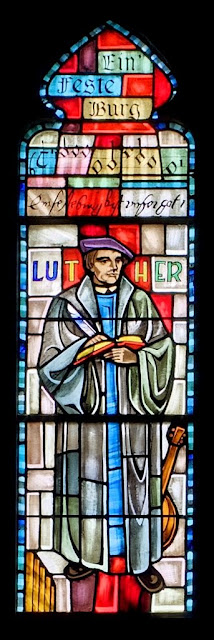
Martin Luther
from Holy Cross, Lutheran Church
Detroit

When Martin Luther posted his 95 Theses against indulgences on October 31, 1517, he didn’t intend to change the world. He intended to reform the Catholic Church’s teaching to bring it back in line with the true teaching of Holy Scripture. Luther wanted to do this so that people could receive the comfort of the Gospel and be led to trust in Christ for their salvation, instead of being driven away from Christ by false teaching. However, it didn’t happen the way Luther intended. Instead of reforming its doctrine to conform to the truth, the Roman church dug in its heels (so to speak) and held fast to its false doctrine (and the ill-gotten riches which they stole from ignorant parish members) to the extent that by the time of the Council of Trent (1545-1563) they enshrined false practices into dogmas which are still taught in the Catholic Church today. Indulgences, for example, are still issued from the Catholic Church even though Martin Luther clearly showed that they were false five centuries ago.

Martin Luther certainly changed the world, and that is the main reason why the world remembers him, but the trouble is that most of the world learned the wrong lesson. The Catholics became entrenched in their false practices which came from bad practices which, over time, had become traditions. The radical reformers, on the other hand, rejected (almost) everything that Rome did, including many good Scriptural Christian teachings and practices. The irony is that both the Roman Catholics and the radical reformers held on to the same semi-Pelagian works righteousness (to a greater or lesser degree) even though that is what prompted Luther to start the Reformation in the first place!

The Intellectual Brilliance of Martin Luther

Martin Luther
from Zion Lutheran Church,
Columbus, Ohio

Martin Luther was a brilliant scholar – probably one of the most brilliant men who ever lived – yet he really taught nothing new. This really ought to be a lesson to those who praise newness above everything else. Luther preferred to be true rather than new. Luthers brilliance was that he used his intellect to determine what was true and what was false. Despite facing opposition from the Pope on the one side, and the radical reformers on the other, Luther taught the Scriptures in their truth and purity and held them to be the true Word of God. The Bible not only tells us of our salvation, but actually delivers Christ’s salvation to those who listen and believe.

Today most schools teach that in order to be considered intellectually brilliant you must discover something new that no one else has ever found. This sounds like a worthy goal, but it is a fallacy. In pursuit of this unreachable goal, scholars are encouraged to make things up that aren’t true, or pursue outrageous ideas which even the ancient peoples rejected because they had already researched and discovered those ideas to be false and/or destructive. Already three thousand years ago, King Solomon studied the world and discovered, “What has been will be again, what has been done will be done again, there is nothing new under the sun.” (Ecclesiastes 1:9) Solomon was right then, and he is still right today. Those who say otherwise are either ignorant of history, or they are trying to deceive people into believing their lies. It is easy to say that something is new, when it has been tried and rejected so thoroughly throughout history that few remember it. Many lazy scholars take this easy way out, instead of doing the hard work of true scholarship. These “new” ideas which simply recycle bad old ideas certainly ought to be rejected.

Martin Luther, in his God-given brilliance, taught the Scriptures against all errors and, in doing so, changed history. This is what the world commends. However, this aspect of Luther’s legacy is trivial. The world is changing all the time, and rarely for the better. What is more important was that Luther’s teaching brought the true comfort of God’s Word to people who were lost in sin and despair. The comfort that they found in Luther’s teaching is the power of God working through His Word, and it has nothing to do with Luther. It was all about Jesus and His saving work to win forgiveness and salvation for all sinners, and how He brings that salvation to us through the Word and Sacraments.


What the world sees as “brilliant” (or at least, exciting)

Luther the Hymnwriter
from Holy Cross Lutheran Church,
Detroit, Michigan

The world is enthralled with what is “new”. It doesn’t matter if the latest “new thing” is true or false, those who promote such things are praised simply because their ideas seem “new”. As it turns out, “newism” is more likely to be false, or immoral, or otherwise destructive. It doesn’t matter to these “newists” if the latest “new thing” is something that will stand the test of time – and will last a thousand years, or if it is just a passing fad that is here today and will be mercifully forgotten tomorrow. In fact, what is praised as “new” is more likely to be only a passing fad, rather than something which has lasting benefit for all people of all times. The “new” fad doesn’t have to have a broad appeal, but can be very narrow. The “new” is most often not healthy, but harmful. It is culturally bound, and does not transcend boundaries. It does not appeal to a broad range of people, but is very specific to only a few people in a severely limited time and space. It does not satisfy a fundamental need within any person, but appeals to base desires and fleeting whims. It does not give honor to people, but degrades them. It does not liberate people, but enslaves them – usually under the pretense of giving “freedom”. It does not build up, but exalts in destruction. It does not unite people, but divides them. Where there is one united people it divides them into subgroups until there is only individuals, and even within an individual it pushes him to war against his own self. It cannot abide true love (selflessness), but promotes a radical selfishness. It does not value life, but always favors death. It cares nothing for the truth, but revels in the boldest lies. It does not give lasting joy, but only fleeting guilty pleasure and lasting pain and suffering. This is the kind of thing that the world exalts as “brilliant”, and is why most people have stubbornly refused to learn the proper lessons from the Reformation.


The True Lesson of the Reformation

It is Christ alone who saves us
from Holy Cross Lutheran Church
Detroit, Michigan

Though we remember Martin Luther as we celebrate the Reformation, the importance of the Reformation is not in Martin Luther. Luther trusted in God’s Word and proclaimed Christ alone as our salvation. Though the world attacks the authority of God’s Word, yet the Holy Scriptures still are true, and have the power to bring you forgiveness and salvation. Remember that when Jesus was tempted in the wilderness He did not use His divine power to resist the devil’s temptations. Instead He simply trusted that the Scriptures are the Word of God, and because Jesus was faithful in all He did, the devil was defeated and has no claim on you. If you are a baptized Christian you belong to Jesus who rescued you from sin and death, and He gives you everlasting life. To God alone belongs all the glory and praise – for He has redeemed us from our sins and brings to us everlasting salvation. Happy Reformation Day!

Tuesday, October 20, 2015

Christ Has Done All Things Well

by Pastor Paul Wolff


Then Jesus left the vicinity of Tyre and went through Sidon, down to the Sea of Galilee and into the region of the Decapolis. There some people brought to him a man who was deaf and could hardly talk, and they begged him to place his hand on the man.

After he took him aside, away from the crowd, Jesus put his fingers into the man’s ears. Then he spit and touched the man’s tongue. He looked up to heaven and with a deep sigh said to him, “Ephphatha!” (which means, “Be opened!”). At this, the man’s ears were opened, his tongue was loosened and he began to speak plainly.

Jesus commanded them not to tell anyone. But the more he did so, the more they kept talking about it. People were overwhelmed with amazement. “He has done everything well,” they said. “He even makes the deaf hear and the mute speak.” (Mark 7:31-37)


Jesus heals us from sin and its consequences
(Liturgical clip art by Clemens Schmidt)

No sinner does everything well. Everything we do is tainted by sin in some way. There is a saying, “Jack of all trades – master of none.” This means you can’t be good at everything. The most you can hope to do is to be good at one thing, and hope that this is a talent for which someone will pay you handsomely. Many people have made their fortune by specializing in one thing or another. This has its downsides though. God have mercy on you if you see a doctor for an ailment which is outside of his specialty.

Jesus truly has done everything well, but because of our sinful nature we don’t really care if Jesus has done everything well. We each want God to say, “You have done everything well,” just as we truly (though wrongly) believe that we already do everything well enough. Yet, if we are honest with ourselves, and measure ourselves up against God’s Law, we must admit that we don’t even come close to doing everything well.

Though, here we must ask: does God really expect us to do ALL things well? Though we hope that the answer is “no” we read in Leviticus 19 where God tells His people, “Be holy because I, the Lord, Your God, am holy.” This passage shows that God does require us to be perfectly holy as God is holy. We should remember, however, that when God first made people He made them holy as He is holy, but our first parents rebelled against God and lost their holiness. We continue in that rebellion. St. Paul quotes from Psalm 14 in Romans 3:10, “There is no one righteous, not even one.” No sinner can do everything well, because we all rebel against God and His righteous laws. There are no exceptions “for all have sinned and fall short of the glory of God.” (Romans 3:23) If we measure ourselves against God’s Law we must join St. Paul in saying, “Christ Jesus came into the world to save sinners of whom I am the worst.” (1 Timothy 1:15)

Faith comes by hearing and believing the Word of Christ
(Romans 10:17)

So while we haven’t done much good, but have instead sinned greatly, Jesus has done all things well. Jesus even makes the deaf to hear and the mute to speak. Jesus said many times, “He who has ears to hear, let Him hear.” But on this day Jesus met a man who had ears that could not hear. So Jesus not only healed the man of his deafness, but gave him the ability to speak, also. Giving the man speech was no less a miracle than healing his deafness. If you know anyone who has been deaf since birth you know how hard it is for deaf people to talk. Though deaf schools do a great job of teaching the deaf how to speak, it is a difficult process, and it takes time. Even if a deaf person were to receive hearing today, it would still take time to learn how to speak clearly, but Jesus gives the man speech immediately. This reminds me of what God did at the Tower of Babel. In one day God gave the people different languages so that they forgot their old language and spoke new ones and couldn’t understand one another. In this case, however, Jesus gave this man speech so that he could be heard and understood by his friends and family.

Jesus did this out of compassion for the man. He didn’t do this for publicity, and certainly not to be known as a miracle worker. In fact, Jesus took the deaf man away from the crowd and put his fingers in his ears and spat and touched his tongue and healed him. I’m not sure what the spitting was all about, but it is likely that he touched the man’s ears and tongue to show the man what he was doing in healing him.

Then after giving the man hearing and speech, Jesus ironically told the man not to tell anyone what He had done. I think Jesus did this because since the man had only just then received his hearing and speech, he had an incomplete understanding of Jesus. He knew Jesus as a gracious miracle worker, but that is all. He needed to listen more and talk less, but he was a sinner, and it seems as though he preferred to exercise his gift of speech over his gift of hearing, even against Christ’s command to him. It was certainly true what the man said of Jesus, “He has done all things well. He makes both the deaf to hear and the mute to speak.” But this is an incomplete picture of Jesus.

The Law of God kills the sinner,
but Jesus gives Life to all who believe.

It is not necessarily good news for anyone that Jesus does everything well. If Jesus were any less than the merciful and holy God, He might still condemn us, saying, “Look! I lived the holy and obedient life. Why can’t you!” That would be true, and we would be condemned. This is why the Scripture says that the Law of God “Kills” and “brings death.” (2 Corinthians 3:6) It was necessary for our salvation that Jesus obeyed God’s Law and did everything well, however, it wasn’t His obedience to God’s Law that saved us from sin and its consequences. Jesus had to do more than do everything well – and that is exactly what Jesus did.

In order to be worthy to redeem us from our sins Jesus had to obey God’s Law just like any other person, and He had to do it perfectly so that He would not be condemned by His own sin. Romans 5:19 tells us, “Just as through the disobedience of the one man (Adam) the many were made sinners, so also through the obedience of the one man (Jesus) the many will be made righteous.” Jesus actively obeyed all of God the Father’s commandments. But Jesus didn’t do it for His own sake, He did it for us – to make us righteous in God’s sight.

Galatians 4:4-5 also tells us, “When the time had fully come, God sent His Son, born of a woman, born under law, to redeem those under law, that we might receive the full rights of sons.” Jesus lived under God’s law like any other man, but He kept God’s law perfectly so that we might receive His heavenly inheritance as sons. We call this Christ’s Active Obedience. This is what the people were talking about when they said, “Jesus has done all things well.”

But in itself this doesn’t save us. Jesus had to go further to redeem us from the guilt of our sins. Jesus offered his life in exchange for ours. Jesus, in effect, said to the Father, “Don’t punish my brothers and sisters for the sins they committed against You. Punish me instead, and set them free from their sin.” This is what St. Paul described in Colossians 1:22, where he wrote, “(God) has reconciled you by Christ’s physical body through death to present you holy in His sight, without blemish and free from accusation.” Since Jesus has taken the punishment for your sins, there is no longer anything standing between you and your heavenly Father.
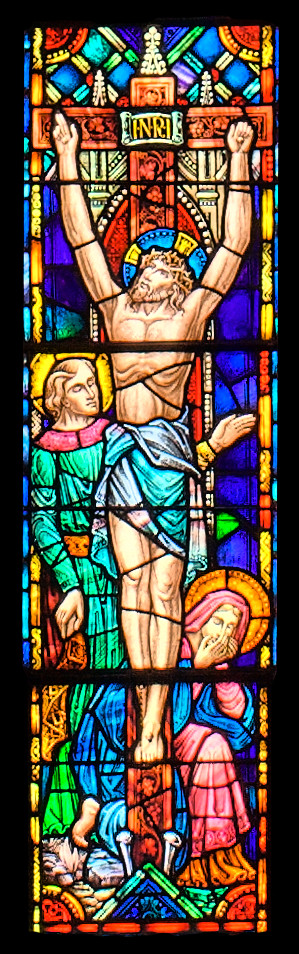
Though Jesus is the Almighty God,
it was not without cost that He healed us from our sin.
This was the cost.

Jesus truly treats us as His brothers and sisters, as Hebrews 2:14 says “Since the children have flesh and blood, He too shared in their humanity so that by His death He might destroy him who holds the power of death–that is, the devil.”

Jesus not only shared in our humanity, He shared in our suffering because of our sin. If you notice in Mark 7:34 after Jesus touched the deaf man’s ears and tongue He looked to heaven and sighed. The word for “sigh” here is used elsewhere in the New Testament and is translated as “groan”, as in 2 Corinthians 5:4 which says, “For while we are still in this tent (of our sinful body), we groan, being burdened – not that we would be unclothed, but that we would be further clothed, so that what is mortal may be swallowed up by life.” We groan in our lives because sin causes us great sorrow and pain.


When Jesus healed this deaf man He groaned because He was taking the man’s suffering into Himself and giving him His life and healing. Though Jesus is the almighty God, it was not without cost that He healed people from their infirmities. It caused Him suffering. This is why God says in Isaiah 42:18-19 “Hear, you deaf, and look, you blind that you may see! Who is blind but my servant, or deaf as my messenger whom I send? Who is blind as my dedicated one, or blind as the servant of the Lord?”

Deafness and all our other bodily ailments come to us as a result of sin. When God made Adam and Eve they were perfectly healthy and immortal. Illness and infirmity and death only came after the fall into sin. Jesus rescues us from sin and all its consequences by taking our sin and its consequences into his body. This is why Scripture says in Isaiah 53, “Surely he has borne our griefs and carried our sorrows; yet we esteemed him stricken, smitten by God, and afflicted. But he was wounded for our transgressions, he was bruised for our iniquities; upon him was the chastisement that made us whole, and with his stripes we are healed.”

This is why when Jesus came to be baptized, John objected saying, “I need to be baptized by you.” But Jesus said, “It is fitting for us to fulfill all righteousness.” Jesus fulfilled all righteousness not only by obeying God’s Law perfectly, and doing all things well, but also by taking the pain and guilt and all consequences of our sin into His body. St. Paul describes this in 2 Corinthians 5:21 “God made him who had no sin to be sin for us, so that in him we might become the righteousness of God.”

The miracles Jesus did give us a glimpse into
what heaven is like where all believers
will be healed and glorified by His grace.

It hurt Jesus to heal people from their illnesses and from all the consequences of their sins. Yet, He did not let this stop Him from healing anyone, nor did it stop Him from going to the cross and suffering and dying there for the sins of the world, and for your sins. Jesus did this because He loves You more than He loves Himself. This is the love that our God has for us – that He would take up the pain and suffering of our sin and take it to His grave in order to save us from having to endure that suffering for eternity. This is why we, as God’s children, sorrow in our sins – not just for the suffering that it causes us, but for the suffering that we inflict on Jesus for the sake of our sins. God have mercy on us sinners.

God our heavenly Father does have mercy on us for the sake of His Son, Jesus Christ. This miraculous healing and all of Christ’s miracles are a little taste of His heavenly kingdom where He will rescue us from death and restore us to perfect holiness and life and health forever. Jesus has taken the guilt and the pain of our sins into His body and has taken them to His grave. Yet when Jesus rose from the dead He rose victorious over sin and death, so that He might give us, His beloved children, the gift of eternal life with Him in paradise – without sin – without illness – without sorrow – without death. Jesus truly has done all things well for us and for our salvation that He might share with us the eternal riches of His heavenly Kingdom.


Monday, August 17, 2015

Jesus is the True Bread of Life

by Pastor Paul Wolff


Not all who heard Jesus teach believed in Him


From this time many of his disciples turned back and no longer followed him. “You do not want to leave too, do you?” Jesus asked the Twelve. Simon Peter answered him, “Lord, to whom shall we go? You have the words of eternal life. We believe and know that you are the Holy One of God.”
(John 6:66-69)


In our culture it is commonly accepted that in order to win someone to your point of view that you must convince them in some way, and whatever you do – you must not offend them. Offense seems to be the considered the great “sin” in our society, and yet people have such thin skin that they take offense as often as they take a breath. This is because from a young age we have been influenced by the television and its advertisements. The purpose of ads is to motivate you to spend your money on a certain product or service, but the way they do this is often through the use of deception, manipulation, and lies. We are bombarded with these messages from a young age, so that we don’t even question it after a while. Because of this we are familiar with lies, and offended by the truth.

Jesus doesn’t work this way. Jesus gives a hard teaching to His followers, and they take offense, and they start to leave Him. But Jesus doesn’t try to stop them. He doesn’t try to convince them. He doesn’t say, “No, you misunderstand me, this is what I really meant …” Instead, he piles it on. He gives them more reason to take offense so that many who had been following Him turned back and no longer followed Him. Jesus wasn’t being mean in doing this, nor was He naïve or foolish. He was teaching the truth, but the truth can be hard to accept at times, but the truth is always better than a lie. After many people left Him Jesus then turned to His twelve disciples and said to them, “Do you want to go away as well?” Jesus wasn’t going to compromise the truth even for His closest disciples. If they found it too hard to accept then Jesus would drive them away, too.

Peter spoke for the disciples and said, “Lord, to whom shall we go? You have the words of eternal life.” The teaching of God’s Word is difficult, and it offends all of us at one time or another, because we are all sinners, and God’s Law condemns us for our sin – so we are offended. But God’s Word also teaches the Gospel which brings us salvation from our sin through the redemption which Jesus won for us. God’s word gives us eternal life! Are we going to take offense and turn away and run after something else which doesn’t give eternal life, or are we going to repent and trust in Jesus to save us?

What Jesus was teaching about which caused the people to take offense was food. Now you would not normally think that food would be a divisive topic, but you should remember that ever since the days of Moses the Israelites had lived under God’s ceremonial laws, which placed certain limits on the kinds of food that the people ate. For over a thousand years food was very much on the minds of the people, and what Jesus was teaching seemed to contradict that. Jesus was actually not contradicting the Old Testament dietary laws, He was fulfilling them!


Daily bread is a gift from God - even to all evil people

I assume that most of you have experience with food. Even if you were born yesterday you would still have one day’s experience with food. Food sustains life. It doesn’t give life, but food gives us the energy and nourishment to keep on living and to grow. Food is a necessity for us every day – or if you are like me, you may have stored up some extra food so that you can survive a day or two (or ten) without food.  

It is also a bonus that much of the food we eat also gives us pleasure. God has blessed us so that we can enjoy the food which sustains our life. It is a joy to eat a good meal. Though sometimes we can enjoy our food too much, so we must take our pleasure with food in moderation. If we use the pleasure we get from food to try to make up for some pain or sadness, then we can overindulge and then the food which ought to sustain our life can also damage it. Good food is a gracious gift from God, so enjoy your food, and thank God for it, but be careful not to overdo it.

But we need to remember that the food we eat does not give life, it only preserves it. No earthly food can keep you alive forever. There is no “fountain of youth”. If you watch the advertisements on TV without a discerning eye you might be led to believe that there is a certain food or medicine which can prolong your life indefinitely, if not make you live forever. However, it is not true. Even if there was a perfect food which provided all your needs and did not poison you, you would still die. Death comes as a result of sin, and sin is a disease which affects us all. You can have the perfect diet and exercise habits, and you will still die. That is our greatest problem.


Jesus is the True Bread from heaven

But, Jesus is the solution to our problem of sin and death. Jesus said, “I am the living bread that came down from heaven. If anyone eats this bread, he will live forever. This bread is my flesh, which I will give for the life of the world.” (John 6:51) Jesus is the bread of life, and He doesn’t just sustain our life of sin, instead Jesus gives us life without sin and death. Christ’s flesh is the bread of life because He sacrificed His flesh and blood to pay the price for our sin so that He could redeem us and give is eternal life. Jesus also said, “Unless you eat the flesh of the Son of Man and drink His blood, you have no life in you. Whoever eats my flesh and drinks my blood has eternal life, and I will raise him up at the last day.” (John 6:53-54)

Well, maybe you can begin to see why the Jews were upset about Christ’s teaching. Jesus had not yet instituted the Lord’s supper, so they didn’t know what the Sacrament was all about, but then even today when we have the clear teaching of Scripture, many Christians still don’t understand (or don’t believe) what the Lord’s Supper is all about. Eating a man’s body sounds like cannibalism, which God has always forbidden. Jesus was not talking about cannibalism, but He does give us His flesh and blood for eternal life. When a cannibal eats a person he cannot do it without causing great bodily harm to his victim, and he doesn’t receive the whole person, but only a part; and it doesn’t give him life any more than eating an animal, so he treats his neighbor no better than an animal. These are all reasons why God forbids cannibalism, and condemns it as a terrible sin.

However, when Jesus gives us His body and blood to eat and drink in the Lord’s Supper it is not like cannibalism – but not for the reasons you may have heard. Some unbelievers say that the Lord’s Supper is just a symbolic act – that the communicants don’t really receive the Body and Blood of Jesus. That is not true. Jesus said, “This is my body” and “This is my blood”. That is what He gives to us in the Lord’s Supper. But in the Sacrament we don’t just get a part of Jesus – we get all of Him. And though we eat His body and drink His blood, He is not harmed by this at all. Yet we get blessings far greater than any other food we may eat.


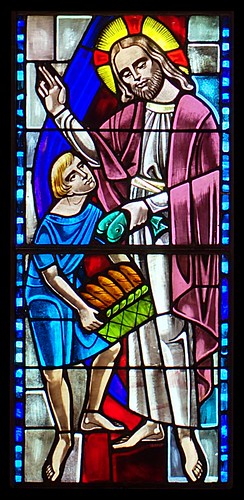
Jesus fed 5,000 people with 5 loaves of bread
and 2 fish with 12 full baskets left over
after everyone had eaten their fill.

The Jews asked themselves, “How can this man give us his flesh to eat?”, but this is the wrong question. Jesus is God incarnate. Jesus fed 5,000 people with 5 loaves of bread and 2 fish, and when everyone had eaten their fill collected 12 baskets of leftovers. If Jesus desires to give His whole body and blood to each of the two billion Christians in the world who each only eat a small morsel of unleavened bread and drink a small sip of wine, then He can do it. Are we going to doubt Jesus – who died and rose to life again? “To whom shall we go? {Jesus} is the Word which gives us eternal life!”

If you find this hard to understand you should take comfort in knowing that no one can really understand this fully. It is a miracle from God – who can understand it? Yet though we do not understand it, we trust the clear words of Jesus that He gives us this great gift for our blessing. For our forgiveness and eternal life.

However, although everyone who eats the Lord’s Supper receives the Body and Blood of Jesus in the bread and wine, not all receive the blessings. Only those who believe the words of Jesus receive the blessings of forgiveness and eternal life. How this works is that those who believe receive the gift of Jesus and hold on to Him by faith, and never let Him go, and so receive the blessings. But when an unbeliever receives the Body and Blood of Jesus he denies the truth of what he has received and he rejects it and throws it away as if it were no more than a small piece of bread and a sip of wine.

This is one reason why the vast majority of Christian churches throughout history and even now throughout the world practice closed communion. In 1 Corinthians 11:27-30 St. Paul instructs the Corinthians saying,
Therefore, whoever eats the bread or drinks the cup of the Lord in an unworthy manner will be guilty of sinning against the body and blood of the Lord. A man ought to examine himself before he eats of the bread and drinks of the cup. For anyone who eats and drinks without recognizing the body of the Lord eats and drinks judgment on himself. That is why many among you are weak and sick, and a number of you have fallen asleep.
Jesus gives us His body and blood
in the bread and wine of the Sacrament
for our forgiveness and eternal life.

We eat and drink unworthily if we do not believe. The Lord’s supper is for sinners, but only for those who believe, and those who share a common confession. We don’t commune with Baptists, or Roman Catholics, or heretical Lutherans, (for example) because we do not agree with their false teachings – even though there may be true Christian believers in all these churches. But we don’t want to give people the impression that we agree with false teaching.

The Reformed churches (Calvinist and Arminian) practice open communion because they do not believe the words of Jesus, and they also ignore Saint Paul’s warnings that “anyone who eats and drinks (the Lord’s Supper) without recognizing the body of the Lord eats and drinks judgment on himself.

These are hard teachings. Perhaps you who are reading this doubt the clear teachings of Scripture because you think they are too hard to believe. Are you considering turning away and going somewhere else? To whom shall you go? These are the teachings of Jesus which bring eternal life. You may find teachers which are easier to hear, but they will not give you eternal life which is the true bread from heaven, Jesus Christ.

If you do not believe the words of Jesus you should refrain from receiving the Sacrament – at least until you can study the Scriptures and see that this is the true teaching of Christ for your salvation.

It is hard to trust the words of Jesus. No one can believe unless the Holy Spirit gives faith, but He works through the Word to give you that faith so that you may believe and that you may find your salvation in Jesus Christ. Only Jesus gave His life as a payment for your sins. Only Jesus comes to you in His sacraments to forgive your sins and give you eternal life. May God, the Holy Spirit, strengthen your faith so that you may say with St. Peter, “Lord, to whom shall we go? You have the words of eternal life.”


For more on a similar topic see: Was Jesus Unloving?


Monday, July 27, 2015

The Promise of Christ in Water & Light

by Pastor Paul Wolff


Then God said to Noah and to his sons with him: “I now establish my covenant with you and with your descendants after you and with every living creature that was with you – the birds, the livestock and all the wild animals, all those that came out of the ark with you – every living creature on earth. I establish my covenant with you: Never again will all life be cut off by the waters of a flood; never again will there be a flood to destroy the earth.”

And God said, “This is the sign of the covenant I am making between me and you and every living creature with you, a covenant for all generations to come: I have set my rainbow in the clouds, and it will be the sign of the covenant between me and the earth. Whenever I bring clouds over the earth and the rainbow appears in the clouds, I will remember my covenant between me and you and all living creatures of every kind. Never again will the waters become a flood to destroy all life. Whenever the rainbow appears in the clouds, I will see it and remember the everlasting covenant between God and all living creatures of every kind on the earth.” (Genesis 9:8-16)


Fish graphic supplied by GospelGifs.com.
It is copyrighted and used with permission.
The early Christians had a clever way to describe Jesus. They made an acronym out of the phrase, “Jesus Christ, God’s Son, Savior,” which in Greek spelled the word for “fish.” This is one of the reasons why the fish became a symbol for the Christian faith. The fish is still a popular symbol for the Christian faith. The second century Church father, Tertullian, used this image in an essay on Baptism where he said, “We are born in water as little fish in the way of our fish Jesus Christ.” Tertullian was responding to a false Gnostic–influenced teacher who was trying to abolish the practice of Baptism in the church. Tertullian explained that the little fish can only survive in the water. If the little fish leave the water of Baptism to follow a false teacher, then they will perish.

This is a wonderful image of the life-giving and sustaining power of Holy Baptism, but it doesn’t seem to work well with our Scripture from Genesis 9. Man is not a fish, and in the great flood every person on earth drowned except Noah, Shem, Ham, and Japheth, and each man’s wife – eight people in the whole world survived the flood.

The story of the flood is frightening because in it we see a just God rightly bringing judgment to a world full of sinners. Yet, we are all sinners. We have all sinned against God and deserve His wrath and punishment. What is more, we are born sinners. We are guilty from the moment of our conception – having inherited the sinful condition from our parents. Even if there was something we could do to make up for our actual sins (there isn’t) there is nothing we can do to change our inherited sin.

How do we know that God won’t bring His righteous judgment down on us? Well, that is exactly the question which is answered in Genesis 9.


Noah trusted in God’s promise of a savior.
The first thing we need to remember is that God spared eight people from the flood – along with two of every kind of living creature, and seven of all the ‘clean’ animals. Now, you may ask, “What is eight people among the thousands, perhaps, millions of people on the earth at the time?” In response I will ask a more pertinent question, “Why did God bother to save Noah’s family at all?”


Scripture describes Noah as a righteous man (Genesis 6:9), but the scriptures also show that neither Noah, nor his sons, were sinless. After the flood God said, “I will never again curse the ground for man’s sake, although the imagination of man’s heart is is evil from his youth; nor will I destroy every living thing as I have done.” (Genesis 8:21) This is almost exactly what God said before the flood. (See Genesis 6:5-7) So, if God did not eliminate sinners from the world, then why did He save Noah and his family? It was purely out of His grace for the sake of a promise God had given Adam and Eve that one of their descendants would crush the serpent’s head and bring redemption to all people. Christ had not yet come in the days of Noah, so God saved Noah’s family in order to keep His promise and bring salvation to the world through Christ.

God keeps His promises, so when He says, “Never again will I destroy every living thing as I have done,” we can rest assured that God will keep this promise. Also God designates the rainbow as a sign of this promise. A rainbow is nothing but raindrops and light, and although it is one of the most beautiful things in creation, it is not the colors which make it a symbol of God’s promise, but its shape. It is shaped like a bow – a weapon of war. But instead of shooting arrows, the rain was God’s weapon to destroy all the unbelieving, violent people on earth.


God has set his bow in the clouds,
and has promised never to use it against us again.

Then, after the flood, God said, “I have set my bow in the cloud, and it shall be a sign of the covenant between me and the earth.” (v. 13) Here God is saying that He is hanging up His weapon – out in the open, for all to see. Though you should notice that when God establishes the rainbow as a symbol of His promise that it isn’t primarily a symbol for you and me. It is a reminder for God Himself! He says, “The rainbow shall be in the cloud, and I will look on it to remember the everlasting covenant between God and every living creature of all flesh that is on the earth.” (v. 16) This should be a triple comfort for us. 1) God promises not to destroy us, despite our sin. 2) The sign is not for us to remember, but for Him, and He will never forget, even if we do forget. 3) God is not up in heaven somewhere far away, but that He is right here with us, because rainbows are only visible on the earth.

That third comfort is a little hard to imagine for us who are used to seeing rainbows here on earth. I remember one time I was in an airplane in the middle of the day. We were flying above the clouds, and I looked out the window and saw the shadow of the airplane on the clouds beneath us. Surrounding the shadow of the plane on the clouds was a circular prism of light. It wasn’t shaped like a bow, but a perfect, full ring of light. If we imagine that God is somewhere in the heavens, high above the clouds, then He would not see a rainbow, but a full circle of light. For God to see the rainbow (as He said He would), He must be down here with us, standing on the earth. God is not far away – high above the clouds. He is right here with us at all times. 

If you remember that I said earlier that the image of the fish didn’t seem to work so well with this story, but in St. Peter’s first Epistle he makes the connection between the flood and Baptism. He says,

“God’s patience waited in the days of Noah, while the ark was being prepared, in which a few, that is, eight persons, were brought safely through water. Baptism, which corresponds to this, now saves you, not as a removal of dirt from the body but as an appeal to God for a good conscience, through the resurrection of Jesus Christ, who has gone into heaven and is at the right hand of God, with angels, authorities, and powers having been subjected to him.” (1 Peter 3:19-21)
You should remember that Noah took two of every kind of land animal and bird, but he did not take any fish on the ark, because the flood was not a great danger to the fish. (Though we can see from the fossil record that some fish were caught in the sediment from the flood, but it wasn’t a great extinction threat compared to the land animals.) But God treated Noah and his family as if they were fish. God spared Noah and his family for the sake of our fish – Jesus Christ, God’s Son, our savior.

Noah and his family trusted in God. They built the ark and they went inside with all the animals trusting that God would not only bring the flood, but would protect them and see them safely through it. Their trust in God to save them made them little fishes belonging to our savior Jesus Christ.

It is very sad that there were likely no believers that drowned in the flood. St. Peter also called Noah a “preacher of righteousness,” but no one besides his immediate family joined him on the ark. The way of the world is that sinners do not acknowledge their sin. We do not see the great peril that we are in, nor acknowledge that the judgment of God is just. The way of the world is seductive. The world thinks that its wicked ways are great fun, and tries to lure the little fish away from the protection of the Baptismal waters. But the little fish cannot survive if lured away from the water.


Jesus was baptized into the guilt of your sin
so you could be baptized out of it.
If you have been baptized you have salvation in Christ. Would you live in God’s Baptismal grace as a child of Christ your savior, or would you rather follow the ways of the world? If the whole world decides to abandon Christ, is it wise to follow only for the pleasure of the moment? In the days of Noah the whole world did abandon God as their savior, and they all perished. But Noah and His family were saved on account of Christ, by believing God’s promise to send a savior (Jesus).

The covenant God made to not destroy the world again with a flood was made on account of Christ. God has every right to punish us for our sins, but He poured out His wrath on Jesus instead. Jesus suffered and died on the cross, taking the punishment for the sins of the whole world so that we need never fear the wrath of God. Through Holy Baptism, not only are our sins washed away, but we are given a new birth as God’s Children. Like Noah, we are saved by God’s grace for Christ’s sake. If “Jesus Christ, God’s Son, Savior” is the fish, then through Baptism we are born as little fishes. We need not fear the coming judgment, nor the wrath of God. We are safe in the waters of Holy Baptism. Even if the whole world turn away from Christ, we will remain with Him, both now and for all eternity – little fish under the protection of our one, true fish Jesus Christ, God’s Son, Our Savior.

Sunday, July 19, 2015

The Sovereignty of God

by Pastor Paul Wolff

The Crown of Life
from Zion Lutheran Church, Columbus, Ohio
The Sovereignty of God is the Biblical teaching that God rules as King and there is no one above Him that He must answer to. This is one of the key attributes of God as the Holy Scriptures clearly show in many passages. One example of this is Deuteronomy 10:17 which says, “For the Lord your God is God of gods and Lord of lords, the great God, mighty and awesome, who shows no partiality and accepts no bribes.” However, though God is Sovereign, that is NOT His primary attribute. God’s primary attribute is His mercy, for which all Christians are eternally grateful.

The teachings of Calvinism hold that God is sovereign above all else, and His sovereignty never gives way to any of His other attributes. This leads Calvinists into false teachings such as double predestination, which wrongly says that God predestines some people to salvation and others to damnation. They rationalize that if God is sovereign above all else, then He determines all things that happen, both good and bad. As a result of this false teaching, Calvinists end up with a god who is essentially evil, because he is responsible for evil. This is one reason why many Calvinists end up as atheists. This teaching of Calvinism overlooks one glaringly obvious teaching of Scripture, and is refuted on nearly every page of the Bible, which I will do below.

Opposite to many of the teachings of Calvinism are the teachings of Arminianism, which holds that man has free will. In practice this means that they essentially believe man is sovereign. This is so obviously false that it would be laughable if it didn’t lead so many people to their destruction. If sinful man has free will then he can do as he wills, and therefore has this power over God. This is so easy to prove wrong that I have already refuted this in the first paragraph above in the Deuteronomy passage where God rules over all other gods and lords (including the willful Christian). Arminianism leads people to atheism (or the worship of one’s self as god) even more quickly than Calvinism. (If you wonder how both Calvinism and its opposite can both be wrong see my article, “Heresies and Half-Truths”).

Although God’s sovereignty is one of the main attributes ascribed to Him in Holy Scripture, it isn’t His primary attribute. This is to say that although God is sovereign, He doesn’t exert His sovereignty to the exclusion of all His other attributes. It is easy to show this, and I can do it with just one word: Jesus.

God humbled Himself to be born of the Virgin Mary
The life of Jesus shows us that God’s sovereignty is not His primary attribute. From the moment of His incarnation at His conception, Jesus humbled Himself to live as one of the people He created. This is so beautifully described by Saint Paul in Philippians 2:5-8, “Your attitude should be the same as that of Christ Jesus: Who, being in very nature God, did not consider equality with God something to be grasped, but made himself nothing, taking the very nature of a servant, being made in human likeness. And being found in appearance as a man, he humbled himself and became obedient to death – even death on a cross!” Though Jesus was (and is) the sovereign God, He did not exert His sovereignty during His earthly ministry. If He had, He wouldn’t have been born in Bethlehem, and He certainly wouldn’t have been caught dead (so to speak) lying in a manger. And speaking of being caught dead, if Jesus had been sovereign above all else, He certainly wouldn’t have been caught dead (literally) nailed to a cross. But then He would have had to exert His sovereignty to condemn us all for our rebellion against Him, and there would be no forgiveness or salvation for anyone.

Jesus humbled Himself and did not succumb
to the temptation to rule on earth as king.
(See Luke 4:1-13)
Both in His life, and in His death, Jesus shows that His primary attribute is His mercy. Though Jesus is, and was, the almighty sovereign God, He set aside His mighty power and authority in order to win forgiveness and salvation for us poor helpless sinners. Jesus said, “my kingdom is not of this world” (John 18:36) and He lived that out from His conception to His death. Jesus did this on account of His mercy, so that He could save us from our sin. Christ’s death on the cross is not a sign of His weakness, but of His humbleness and love for the people He created. (See my article: “The Humble God”)

Saint Paul describes Christ’s humility when he writes that “(Christ) is the image of the invisible God.” (Colossians 1:15) This means that because Jesus is God incarnate as a man, He does exactly what God the Father or the Holy Spirit would do because He is One God with the Father and the Spirit. So God is not ashamed to humble Himself because Jesus is not ashamed to humble Himself and show mercy. Jesus Himself taught, “The Son of Man came not to be served, but to serve and to give His life as a ransom for many.” (Matthew 20:28) Not only is Jesus merciful, but He delights in being a servant for the sake of His beloved people in order to save us from the consequences of our sin.

What this means for Christians is that since the Son of God humbled Himself, we, too, ought to live humble lives. There is much admonition in the Scriptures for Christians to be humble. This is, in part, because we are God’s creation, and all people should humbly recognize Gods rule as our King and creator. But Christians especially ought to be humble in recognition of the humbleness of the almighty, sovereign God as we see how He acts through Jesus. God does not force anyone to believe in Him, so He does not exercise His sovereignty in that way also, but to all who believe in Him He rescues from sin and gives eternal life.

Jesus humbled Himself
to save you from your sins
(Window from Holy Cross Lutheran Church
Detroit, Michigan)
If God always acted in a sovereign way then He would never let adulterers and other sexual sinners harass Christians as they now boldly do here in New Sodom (formerly, the United States of America). Don’t get me wrong, I do not mind so much being called a bigot and hateful, especially since I know it isn’t even close to being true, and I certainly do not equate that with persecution. Though I know that such rhetoric is only a small step away from full-blown hate and the kind of persecution that ends in murder. I am aware that although we are likely to head in that direction (and sooner rather than later), we aren’t quite there yet.

Likewise, if Christ always acted according to His sovereignty, he would not let His children be tortured by Muslim Jihadhists (for example) nor crucified, nor beheaded. Muslims take this as weakness on Christ’s part, but even there it is mercy. Jesus died for the sins of the most murderous Jihadhist, and will forgive any and all who repent of their sins and look to Him for Salvation.

Not only is Christ a God who does not ask His followers to become murderers to gain a spot in Paradise, but He Himself paid the price to redeem the worst murderer and idolater. Jesus offers salvation as a free gift to all who trust in Him as their savior from sin. Jesus uses His sovereign power to rescue us from death and to give us eternal life. He doesn’t use His power to prevent the temporal death which must come to all sinners. This is why Christian martyrs are willing to forgive their murderers. Christians know that not only did Jesus pay the price to redeem us from sin and death, but He also has the power to restore us to life everlasting without sin, and He has promised to give eternal life to all who believe in Him.


Thursday, December 25, 2014

Does Jesus Sing?

By Pastor Paul Wolff

Enter His gates with thanksgiving.
Psalm 100
The Christmas season is filled with music and singing. There are so many wonderful songs and carols and hymns that proclaim the wonders of the incarnation of God in the person of Jesus Christ that without them Christmas would feel very different. Every Holy Day in the Christian church has its own music and songs particular to the specific event being celebrated, but none more so than Christmas. The Christmas hymns and carols are so joyful and memorable that they are in a class by themselves.

The music of Christmas has been such an important part of the celebration for centuries that even non-believers have written songs for the season. Many of the songs we hear at Christmas time have nothing to do with the birth of Jesus, nor our forgiveness, nor our salvation, nor anything Christian. This shows just how important the music of Christmas is – that the unbelieving world has to have its own songs to sing at this time which don’t remind them that they are such rotten sinners that God had to become a man in order to save them. But it also brings to mind a question which isn’t often asked: Does Jesus sing?

Notice that I didn’t ask, “Did Jesus sing?” That is a valid question, and I will answer that, too, but although Jesus died around 1,985 years ago (as of 2014), Jesus also rose from the dead and remains a man today, even though He rules creation as the Almighty God and is present everywhere. If Jesus sang during His life and ministry up to His death, then it would be easy to suppose that He still would enjoy singing even in His glorified state.

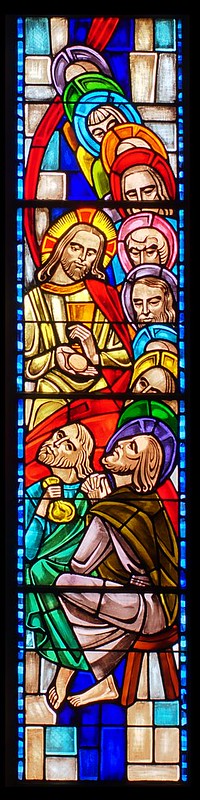
“And when they had sung a hymn, they went out to the Mount of Olives.”
(Matthew 26:30; Mark 14:26)

The Last Supper
The references here are the only verses in the Gospels which suggest to us that, during His earthly ministry, Jesus was a singer, but that is more than enough. I find it interesting that both Matthew and Mark make note of this particular event using the exact same words. It is also interesting that the occasion of this singing was the celebration of the last Passover meal which Jesus shared with His disciples. This celebration was where Jesus instituted the Lord’s Supper. Immediately after this they went to the Mount of Olives where Jesus would be arrested and put on trial.

As someone who greatly appreciates and treasures the hymns of the Church, I would like to have learned more in the Gospels about Jesus singing. As a Christian, I greatly look forward to hearing Jesus sing praises to God, the Father, for His great mercy in sending Jesus to save us; and to God, the Holy Spirit, for gathering us believers in faith to be with Him forever.

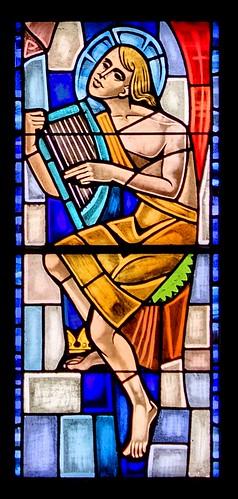
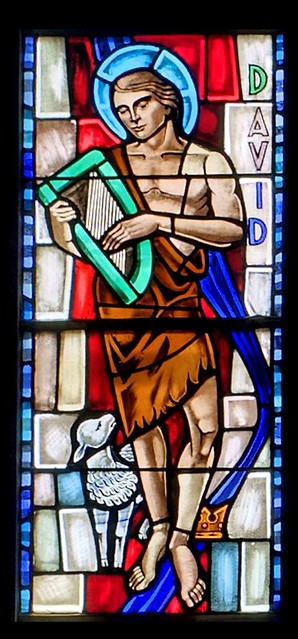
David playing the Harp
From Holy Cross Lutheran Church
Detroit, Michigan
It has been said that the Christian church is a singing church. This has been true even since ancient times in the Old Testament. Consider these verses in the Old Testament:

And Miriam sang to them: “Sing to the Lord, for he is highly exalted. The horse and its rider he has hurled into the sea.” (Exodus 15:21)

The trumpeters and singers joined in unison, as with one voice, to give praise and thanks to the Lord. Accompanied by trumpets, cymbals and other instruments, they raised their voices in praise to the Lord and sang: “He is good; his love endures forever.” (2 Chronicles 5:13)

Sing praises to the Lord, enthroned in Zion; proclaim among the nations what he has done. (Psalm 9:11)

Sing to the Lord, you saints of his; praise his holy name. (Psalm 30:4)

Sing to God, sing praise to his name, extol him who rides on the clouds – his name is the Lord – and rejoice before him. (Psalm 68:4)

Enter into His courts with praise
Psalm 100
Sing to the
Lord a new song; sing to the Lord, all the earth. Sing to the Lord, praise his name; proclaim his salvation day after day. Declare his glory among the nations, his marvelous deeds among all peoples. (Psalm 96:1-3)

Sing to the Lord a new song, for he has done marvelous things; his right hand and his holy arm have worked salvation for him. (Psalm 98:1)

Shout for joy to the Lord, all the earth, burst into jubilant song with music; make music to the Lord with the harp, with the harp and the sound of singing, with trumpets and the blast of the rams horn – shout for joy before the Lord, the King. (Psalm 98:4-6)

Shout for joy to the Lord, all the earth. Worship the Lord with gladness; come before him with joyful songs. Know that the Lord is God. It is he who made us, and we are his; we are his people, the sheep of his pasture. Enter his gates with thanksgiving and his courts with praise; give thanks to him and praise his name. For the Lord is good and his love endures forever; his faithfulness continues through all generations. (Psalm 100:1-5)

There are many more dozens of verses encouraging believers to sing praises to God. There is a sampling of verses at the end of this article below, but you can do a concordance word search for the words “sing” or “singing” or “sang” or “music” and find hundreds of verses which extol the virtues of singing praise to God and making music to tell what He has done to save us.

You should be careful, however, to read the context in doing a word search. Not all singing is God-pleasing, and not even all that pretends to be praising God really does give God praise. Once someone tried to quote Exodus 32:18 to me to try and promote a certain way of praising God, but if you read the context of Exodus 32 you will see that the Israelites were singing in praise of a false god – a golden idol which they had made in direct conflict with God’s First Commandment. This type of praise (pretending to praise God when you are really praising yourself) is not pleasing to God and in reality makes Him angry (because no false god can save us from our sins – only Jesus has done that.)

Window from Holy Cross Lutheran Church
Detroit, Michigan
In fact, there is so much singing in the Scriptures that even without Matthew 26:30 and Mark 14:26 we would almost have to conclude that Jesus is a singer, but with those verses we could say this explains why the Scriptures gladly promote singing as a great gift from God, except when such singing is used to glorify ourselves or some other false god.

The Psalms were the hymns of the Old Testament times. Many of them were written by David, who sang Psalms to King Saul in order to give him comfort when he was tormented by evil spirits. Many (if not most) of the Psalms point to Jesus in a prophetic way. Jesus quoted Psalm 22 when He was hanging on the cross and Christians cannot read Psalm 22 without seeing that entire Psalm as being fulfilled by Jesus on Good Friday. Since Jesus fulfilled all the prophesies of the Old Testament (see Matthew 5:17) and kept God’s commands perfectly (see Hebrews 9:14 and 1 Peter 1:19), so Jesus also must have sung praise to God the Father for sending Him to win our salvation and save us. If such singing is truly a good thing for us sinners to do and is praiseworthy, then it certainly was praiseworthy for the Son of God to sing praises to His Father since He humbled Himself in obedience for our sake (see Philippians 2:5-8). We should not think that we could enjoy something truly good and righteous that Jesus did not, lest we think we are more righteous than God, Himself. That was the Pharisees
’ conceit, and their downfall.

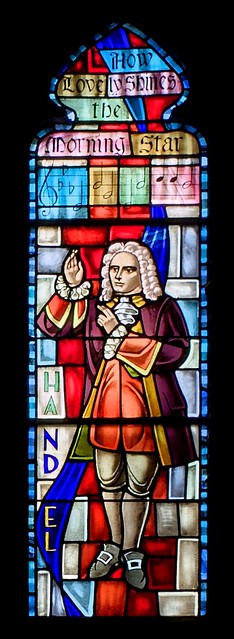
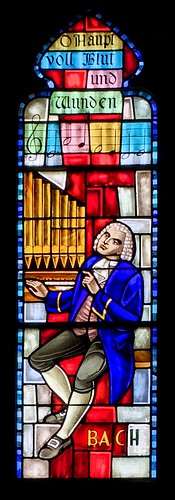
By faith we can say that we hear the voice of Jesus whenever we hear people singing proper praises to God. This can happen when we hear great works like Handel’s “Messiah” or Bach
s liturgical works, or when we hear our choir and congregation singing in Church, or when we hear Christian Christmas carols, or even when a father or mother sings songs or hymns about Jesus to their children.

Window from Holy Cross Lutheran Church
Detroit, Michigan

Martin Luther also extolled music and singing as a gift from God. He wrote:

“Next to the Word of God, music deserves the highest praise. …  For whether you wish to comfort the sad, to terrify the happy, to encourage the despairing, to humble the proud, to calm the passionate, or to appease those full of hate … what more effective means than music could you find? The Holy Ghost himself honors (music) as an instrument for his proper work when in his Holy Scriptures he asserts that through her his gifts were instilled in the prophets, namely, the inclination to all virtues, as can be seen in Elisha [II Kings 3:15]. On the other hand, she serves to cast out Satan, the instigator of all sins, as is shown in Saul, the king of Israel.” *


Because music and singing is so highly praised in the Holy Scriptures as a great gift from God and a great way to proclaim His praises, we can be sure that Jesus also enjoyed and made use of this great gift. We also have Matthew and Mark’s accounts which tell us that Jesus and His disciples sang on at least one occasion, and if they sang during this religious ceremony, they probably sang at other times as well. As a Christian I look forward to meeting Jesus at His return, and singing praise to Him for being my savior. I also look forward to also hearing Jesus sing praise to God the Father and God the Holy Spirit for their work in bringing salvation to all believers.

Have a merry Christmas and enjoy all the beautiful songs which tell how God was born as a baby to pay for our sins and win our salvation through His life and through His death on the cross.


A Sampling of Bible Verses Which Encourage Singing

Window from Holy Cross Lutheran Church
Detroit, Michigan
I will give thanks to the
Lord because of his righteousness and will sing praise to the name of the Lord Most High. (Psalm 7:17)

I will sing to the Lord, because he has dealt bountifully with me. (Psalm 13:6)

Be exalted, O Lord, in your strength; we will sing and praise your might. (Psalm 21:13)

Hear, O Lord, and be merciful to me; O Lord, be my help. You turned my wailing into dancing; you removed my sackcloth and clothed me with joy, that my heart may sing to you and not be silent. O Lord my God, I will give you thanks forever. (Psalm 30:10-12)

I will praise you, O Lord, among the nations; I will sing of you among the peoples. (Psalm 57:9)

Sing to God, O kingdoms of the earth, sing praise to the Lord, (Selah) to him who rides the ancient skies above, who thunders with mighty voice. (Psalm 68:32-33)

I will sing of the Lord’s great love forever; with my mouth I will make your faithfulness known through all generations. (Psalm 89:1)

It is good to praise the Lord and make music to your name, O Most High. (Psalm 92:1)

For you make me glad by your deeds, O Lord; I sing for joy at the works of your hands. (Psalm 92:4)

Come, let us sing for joy to the Lord; let us shout aloud to the Rock of our salvation. Let us come before him with thanksgiving and extol him with music and song. (Psalm 95:1-2)

I will sing of your love and justice; to you, O Lord, I will sing praise. (Psalm 101:1)

I will sing to the Lord all my life; I will sing praise to my God as long as I live. (Psalm 104:33)

Praise the Lord, for the Lord is good; sing praise to his name, for that is pleasant. (Psalm 135:3)

I will praise you, O Lord, with all my heart; before the “gods” I will sing your praise. (Psalm 138:1)

I will sing a new song to you, O God; on the ten-stringed lyre I will make music to you. (Psalm 144:9)

Window from Holy Cross Lutheran Church
Detroit, Michigan
I will praise the
Lord all my life; I will sing praise to my God as long as I live. (Psalm 146:2)

Praise the Lord. How good it is to sing praises to our God, how pleasant and fitting to praise him! (Psalm 147:1)

Sing to the Lord with thanksgiving; make music to our God on the harp. (Psalm 147:7)

Praise the Lord. Sing to the Lord a new song, his praise in the assembly of the saints. (Psalm 149:1)

Do not get drunk on wine, which leads to debauchery. Instead, be filled with the Spirit. Speak to one another with psalms, hymns and spiritual songs. Sing and make music in your heart to the Lord, always giving thanks to God the Father for everything, in the name of our Lord Jesus Christ. (Ephesians 5:18-20)

Let the word of Christ dwell in you richly as you teach and admonish one another with all wisdom, and as you sing psalms, hymns and spiritual songs with gratitude in your hearts to God. (Colossians 3:16)

And they sang a new song before the throne and before the four living creatures and the elders. No one could learn the song except the 144,000 who had been redeemed from the earth. (Revelation 14:3)

And I saw what looked like a sea of glass mixed with fire and, standing beside the sea, those who had been victorious over the beast and his image and over the number of his name. They held harps given them by God and sang the song of Moses the servant of God and the song of the Lamb: “Great and marvelous are your deeds, Lord God Almighty. Just and true are your ways, King of the ages. Who will not fear you, O Lord, and bring glory to your name? For you alone are holy. All nations will come and worship before you, for your righteous acts have been revealed.” (Revelation 15:2-4)


* Martin Luther quote from:
Luther’s Works, Vol. 53 : Liturgy and Hymns. Philadelphia : Fortress Press, 1999, (c) 1965 (Luther’s Works 53), S. 53:323