Showing posts with label Calvin. Show all posts

Saturday, October 31, 2015

The Intellectual Brilliance of Martin Luther

by Pastor Paul Wolff

The Reformation

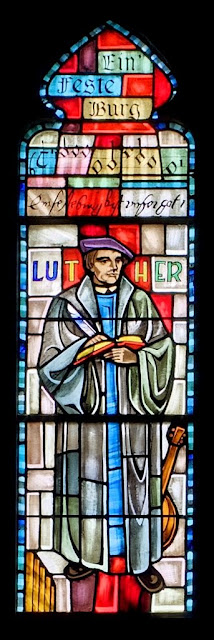
Martin Luther
from Holy Cross, Lutheran Church
Detroit

When Martin Luther posted his 95 Theses against indulgences on October 31, 1517, he didn’t intend to change the world. He intended to reform the Catholic Church’s teaching to bring it back in line with the true teaching of Holy Scripture. Luther wanted to do this so that people could receive the comfort of the Gospel and be led to trust in Christ for their salvation, instead of being driven away from Christ by false teaching. However, it didn’t happen the way Luther intended. Instead of reforming its doctrine to conform to the truth, the Roman church dug in its heels (so to speak) and held fast to its false doctrine (and the ill-gotten riches which they stole from ignorant parish members) to the extent that by the time of the Council of Trent (1545-1563) they enshrined false practices into dogmas which are still taught in the Catholic Church today. Indulgences, for example, are still issued from the Catholic Church even though Martin Luther clearly showed that they were false five centuries ago.

Martin Luther certainly changed the world, and that is the main reason why the world remembers him, but the trouble is that most of the world learned the wrong lesson. The Catholics became entrenched in their false practices which came from bad practices which, over time, had become traditions. The radical reformers, on the other hand, rejected (almost) everything that Rome did, including many good Scriptural Christian teachings and practices. The irony is that both the Roman Catholics and the radical reformers held on to the same semi-Pelagian works righteousness (to a greater or lesser degree) even though that is what prompted Luther to start the Reformation in the first place!

The Intellectual Brilliance of Martin Luther

Martin Luther
from Zion Lutheran Church,
Columbus, Ohio

Martin Luther was a brilliant scholar – probably one of the most brilliant men who ever lived – yet he really taught nothing new. This really ought to be a lesson to those who praise newness above everything else. Luther preferred to be true rather than new. Luthers brilliance was that he used his intellect to determine what was true and what was false. Despite facing opposition from the Pope on the one side, and the radical reformers on the other, Luther taught the Scriptures in their truth and purity and held them to be the true Word of God. The Bible not only tells us of our salvation, but actually delivers Christ’s salvation to those who listen and believe.

Today most schools teach that in order to be considered intellectually brilliant you must discover something new that no one else has ever found. This sounds like a worthy goal, but it is a fallacy. In pursuit of this unreachable goal, scholars are encouraged to make things up that aren’t true, or pursue outrageous ideas which even the ancient peoples rejected because they had already researched and discovered those ideas to be false and/or destructive. Already three thousand years ago, King Solomon studied the world and discovered, “What has been will be again, what has been done will be done again, there is nothing new under the sun.” (Ecclesiastes 1:9) Solomon was right then, and he is still right today. Those who say otherwise are either ignorant of history, or they are trying to deceive people into believing their lies. It is easy to say that something is new, when it has been tried and rejected so thoroughly throughout history that few remember it. Many lazy scholars take this easy way out, instead of doing the hard work of true scholarship. These “new” ideas which simply recycle bad old ideas certainly ought to be rejected.

Martin Luther, in his God-given brilliance, taught the Scriptures against all errors and, in doing so, changed history. This is what the world commends. However, this aspect of Luther’s legacy is trivial. The world is changing all the time, and rarely for the better. What is more important was that Luther’s teaching brought the true comfort of God’s Word to people who were lost in sin and despair. The comfort that they found in Luther’s teaching is the power of God working through His Word, and it has nothing to do with Luther. It was all about Jesus and His saving work to win forgiveness and salvation for all sinners, and how He brings that salvation to us through the Word and Sacraments.


What the world sees as “brilliant” (or at least, exciting)

Luther the Hymnwriter
from Holy Cross Lutheran Church,
Detroit, Michigan

The world is enthralled with what is “new”. It doesn’t matter if the latest “new thing” is true or false, those who promote such things are praised simply because their ideas seem “new”. As it turns out, “newism” is more likely to be false, or immoral, or otherwise destructive. It doesn’t matter to these “newists” if the latest “new thing” is something that will stand the test of time – and will last a thousand years, or if it is just a passing fad that is here today and will be mercifully forgotten tomorrow. In fact, what is praised as “new” is more likely to be only a passing fad, rather than something which has lasting benefit for all people of all times. The “new” fad doesn’t have to have a broad appeal, but can be very narrow. The “new” is most often not healthy, but harmful. It is culturally bound, and does not transcend boundaries. It does not appeal to a broad range of people, but is very specific to only a few people in a severely limited time and space. It does not satisfy a fundamental need within any person, but appeals to base desires and fleeting whims. It does not give honor to people, but degrades them. It does not liberate people, but enslaves them – usually under the pretense of giving “freedom”. It does not build up, but exalts in destruction. It does not unite people, but divides them. Where there is one united people it divides them into subgroups until there is only individuals, and even within an individual it pushes him to war against his own self. It cannot abide true love (selflessness), but promotes a radical selfishness. It does not value life, but always favors death. It cares nothing for the truth, but revels in the boldest lies. It does not give lasting joy, but only fleeting guilty pleasure and lasting pain and suffering. This is the kind of thing that the world exalts as “brilliant”, and is why most people have stubbornly refused to learn the proper lessons from the Reformation.


The True Lesson of the Reformation

It is Christ alone who saves us
from Holy Cross Lutheran Church
Detroit, Michigan

Though we remember Martin Luther as we celebrate the Reformation, the importance of the Reformation is not in Martin Luther. Luther trusted in God’s Word and proclaimed Christ alone as our salvation. Though the world attacks the authority of God’s Word, yet the Holy Scriptures still are true, and have the power to bring you forgiveness and salvation. Remember that when Jesus was tempted in the wilderness He did not use His divine power to resist the devil’s temptations. Instead He simply trusted that the Scriptures are the Word of God, and because Jesus was faithful in all He did, the devil was defeated and has no claim on you. If you are a baptized Christian you belong to Jesus who rescued you from sin and death, and He gives you everlasting life. To God alone belongs all the glory and praise – for He has redeemed us from our sins and brings to us everlasting salvation. Happy Reformation Day!

Sunday, July 19, 2015

The Sovereignty of God

by Pastor Paul Wolff

The Crown of Life
from Zion Lutheran Church, Columbus, Ohio
The Sovereignty of God is the Biblical teaching that God rules as King and there is no one above Him that He must answer to. This is one of the key attributes of God as the Holy Scriptures clearly show in many passages. One example of this is Deuteronomy 10:17 which says, “For the Lord your God is God of gods and Lord of lords, the great God, mighty and awesome, who shows no partiality and accepts no bribes.” However, though God is Sovereign, that is NOT His primary attribute. God’s primary attribute is His mercy, for which all Christians are eternally grateful.

The teachings of Calvinism hold that God is sovereign above all else, and His sovereignty never gives way to any of His other attributes. This leads Calvinists into false teachings such as double predestination, which wrongly says that God predestines some people to salvation and others to damnation. They rationalize that if God is sovereign above all else, then He determines all things that happen, both good and bad. As a result of this false teaching, Calvinists end up with a god who is essentially evil, because he is responsible for evil. This is one reason why many Calvinists end up as atheists. This teaching of Calvinism overlooks one glaringly obvious teaching of Scripture, and is refuted on nearly every page of the Bible, which I will do below.

Opposite to many of the teachings of Calvinism are the teachings of Arminianism, which holds that man has free will. In practice this means that they essentially believe man is sovereign. This is so obviously false that it would be laughable if it didn’t lead so many people to their destruction. If sinful man has free will then he can do as he wills, and therefore has this power over God. This is so easy to prove wrong that I have already refuted this in the first paragraph above in the Deuteronomy passage where God rules over all other gods and lords (including the willful Christian). Arminianism leads people to atheism (or the worship of one’s self as god) even more quickly than Calvinism. (If you wonder how both Calvinism and its opposite can both be wrong see my article, “Heresies and Half-Truths”).

Although God’s sovereignty is one of the main attributes ascribed to Him in Holy Scripture, it isn’t His primary attribute. This is to say that although God is sovereign, He doesn’t exert His sovereignty to the exclusion of all His other attributes. It is easy to show this, and I can do it with just one word: Jesus.

God humbled Himself to be born of the Virgin Mary
The life of Jesus shows us that God’s sovereignty is not His primary attribute. From the moment of His incarnation at His conception, Jesus humbled Himself to live as one of the people He created. This is so beautifully described by Saint Paul in Philippians 2:5-8, “Your attitude should be the same as that of Christ Jesus: Who, being in very nature God, did not consider equality with God something to be grasped, but made himself nothing, taking the very nature of a servant, being made in human likeness. And being found in appearance as a man, he humbled himself and became obedient to death – even death on a cross!” Though Jesus was (and is) the sovereign God, He did not exert His sovereignty during His earthly ministry. If He had, He wouldn’t have been born in Bethlehem, and He certainly wouldn’t have been caught dead (so to speak) lying in a manger. And speaking of being caught dead, if Jesus had been sovereign above all else, He certainly wouldn’t have been caught dead (literally) nailed to a cross. But then He would have had to exert His sovereignty to condemn us all for our rebellion against Him, and there would be no forgiveness or salvation for anyone.

Jesus humbled Himself and did not succumb
to the temptation to rule on earth as king.
(See Luke 4:1-13)
Both in His life, and in His death, Jesus shows that His primary attribute is His mercy. Though Jesus is, and was, the almighty sovereign God, He set aside His mighty power and authority in order to win forgiveness and salvation for us poor helpless sinners. Jesus said, “my kingdom is not of this world” (John 18:36) and He lived that out from His conception to His death. Jesus did this on account of His mercy, so that He could save us from our sin. Christ’s death on the cross is not a sign of His weakness, but of His humbleness and love for the people He created. (See my article: “The Humble God”)

Saint Paul describes Christ’s humility when he writes that “(Christ) is the image of the invisible God.” (Colossians 1:15) This means that because Jesus is God incarnate as a man, He does exactly what God the Father or the Holy Spirit would do because He is One God with the Father and the Spirit. So God is not ashamed to humble Himself because Jesus is not ashamed to humble Himself and show mercy. Jesus Himself taught, “The Son of Man came not to be served, but to serve and to give His life as a ransom for many.” (Matthew 20:28) Not only is Jesus merciful, but He delights in being a servant for the sake of His beloved people in order to save us from the consequences of our sin.

What this means for Christians is that since the Son of God humbled Himself, we, too, ought to live humble lives. There is much admonition in the Scriptures for Christians to be humble. This is, in part, because we are God’s creation, and all people should humbly recognize Gods rule as our King and creator. But Christians especially ought to be humble in recognition of the humbleness of the almighty, sovereign God as we see how He acts through Jesus. God does not force anyone to believe in Him, so He does not exercise His sovereignty in that way also, but to all who believe in Him He rescues from sin and gives eternal life.

Jesus humbled Himself
to save you from your sins
(Window from Holy Cross Lutheran Church
Detroit, Michigan)
If God always acted in a sovereign way then He would never let adulterers and other sexual sinners harass Christians as they now boldly do here in New Sodom (formerly, the United States of America). Don’t get me wrong, I do not mind so much being called a bigot and hateful, especially since I know it isn’t even close to being true, and I certainly do not equate that with persecution. Though I know that such rhetoric is only a small step away from full-blown hate and the kind of persecution that ends in murder. I am aware that although we are likely to head in that direction (and sooner rather than later), we aren’t quite there yet.

Likewise, if Christ always acted according to His sovereignty, he would not let His children be tortured by Muslim Jihadhists (for example) nor crucified, nor beheaded. Muslims take this as weakness on Christ’s part, but even there it is mercy. Jesus died for the sins of the most murderous Jihadhist, and will forgive any and all who repent of their sins and look to Him for Salvation.

Not only is Christ a God who does not ask His followers to become murderers to gain a spot in Paradise, but He Himself paid the price to redeem the worst murderer and idolater. Jesus offers salvation as a free gift to all who trust in Him as their savior from sin. Jesus uses His sovereign power to rescue us from death and to give us eternal life. He doesn’t use His power to prevent the temporal death which must come to all sinners. This is why Christian martyrs are willing to forgive their murderers. Christians know that not only did Jesus pay the price to redeem us from sin and death, but He also has the power to restore us to life everlasting without sin, and He has promised to give eternal life to all who believe in Him.