Showing posts with label paradise. Show all posts

Friday, April 7, 2023

Today You Will be With Me in Paradise

Second in a series on the Seven Last Words of Jesus

by Pastor Paul Wolff


One of the criminals who were hanged railed at (Jesus), saying, “Are you not the Christ? Save yourself and us!” 

But the other rebuked him, saying, “Do you not fear God, since you are under the same sentence of condemnation? And we indeed justly, for we are receiving the due reward of our deeds; but this man has done nothing wrong.” 

And he said, “Jesus, remember me when you come into your kingdom.” 

And he said to him, “Truly, I say to you, today you will be with me in Paradise.”
(Luke 23:39-43)
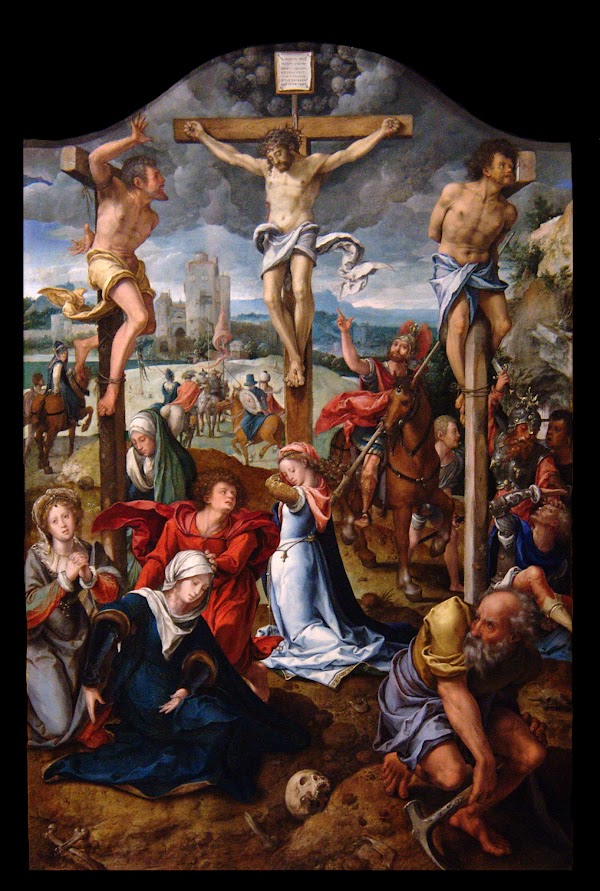

One of the criminals … said,
“Jesus, remember me
when you come into your kingdom.”
And Jesus said to him,
“Truly, I say to you, today you will
be with me in Paradise.”

There is a sarcastic saying which says, “No one is useless. You can always serve as a bad example.” In the ancient Roman empire crucifixion was the ultimate expression of this adage. “Don’t be like this guy, or else you will suffer the same humiliation and torture as him.”

The two men who were crucified along with Jesus were just such people. They were the dregs of society. Roman society had no more use for them, except to use them as a lesson for others. Jesus did not look at them that way. When Jesus prayed, “Father forgive them …” He wasn’t only talking about those who were crucifying Him, and those who conspired for his death. Jesus was praying for the forgiveness of all sinners, including those two who were crucified along with Him.

One of the criminals next to Jesus mocked Him saying, “Aren’t you the Christ? Save yourself, and us!” This taunt sounds like Satan’s temptations of Jesus. “If you are the Christ … If you are the Son of God …” He said this as if he expected Jesus to do what he thought the Christ should do, instead of what God sent Him to do. “Save us!” he said. For what did he want to be saved? Did he want his sinful life restored so he could continue to lie, cheat, steal, and murder? That is not salvation.

The other criminal saw his situation, and he probably heard Jesus praying for his forgiveness, and he repented. He wanted the peace that would lead a crucified man to pray for his tormentors. Such a thing did not happen often, if ever. First, he called his friend to repentance as he confessed the guilt of his sins. “Don’t you fear God? … Our punishment is just, for we are getting what we deserve for what we have done, but this man has done nothing wrong.” The Second use of God’s Law is to show us our sin. The repentant thief recognized his sin and confessed it. The wages of sin is death. All sinners deserve to die for their sins. All sinners deserve to be there dying on the cross. The one man who did not deserve to die was Jesus. Yet there He was dying for sinners.

Then the repentant thief looked to Jesus to save Him. “Jesus, remember me when you come into Your Kingdom.” Truly this is a great example that faith is a miraculous gift of the Holy Spirit. Jesus was being crucified just as the thieves were. Jesus had the power and authority as the Son of God to avoid death, but He didn’t use that power to save Himself. Jesus would die like a man to rescue mankind from sin and death. “Jesus, King of Israel, remember me when you come into Your kingdom.”

Jesus did not laugh at the condemned criminal. He did not treat him like an irredeemable piece of worthless human trash – as the world considered him. Jesus saw him as a beloved child of God – the likes of which Jesus had come to save. Jesus once taught, “There will be more joy in heaven over one sinner who repents than over ninety-nine righteous persons who need no repentance.” (Luke 15:7) Jesus rejoiced to save this lost sinner. Jesus came to save sinners. Here was one looking to Him for salvation. This man was lost, and now he was found. Jesus was not so preoccupied with his own suffering, but He gave comfort to the repentant thief. “Truly, today you will be with me in paradise.”

“Today!” There is no waiting for salvation. There is no purgatory to add to the suffering of life after death. “Today you will be with me in Paradise!” As a sinner, this thief was an enemy of God by nature, but, through faith, Jesus adopted him as his beloved child, and would share with him the inheritance of his heavenly kingdom that very day. What a joy it is to be rescued from sin and death by Jesus. It is sad that this former thief did not have the comfort of salvation earlier in his life. He was late to the party, but not too late, and better late than never.

The salvation of the repentant thief is another example of how salvation is free through faith in Jesus. This man did nothing to save himself. He was dead to the world in the last hours of his life. Yet, Jesus suffered and died to redeem him of his sin. This man’s sin only brought him trouble and hardship in life and directly led to his early death. Yet, the Holy Spirit gave him faith in Jesus and led him to repent of his sin and receive the forgiveness and salvation that Jesus won for him as He died on the cross next to him.

The world has nearly as little use for Jesus as it did for the two thieves crucified on either side of him, and the world tries to get rid of Jesus, even to this day. They do this to sin more – thinking that to sin freely is freedom. Yet, everyone who sins is a slave to sin. (John 8:34) But if the Son sets you free, you are free indeed. (John 8:36) Jesus forgave the repentant man condemned by the world. The world had told him how fun it was to lie, cheat, steal, and murder, then condemned him to death for learning his lesson too well. He still had to die for his crimes, but as a forgiven child of God, heaven was opened to him to live forever in paradise.

Jesus was not ashamed to suffer and die for people such as this poor thief. If Jesus could rescue him from sin and death and give him salvation that very day, then Jesus can also take joy in rescuing you from your sin and death. Hebrews 12:2 says, “Look to Jesus, the founder and perfecter of our faith, who, for the joy set before Him endured the cross, scorning its shame, and is seated at the right hand of the throne of God.” The repentant thief looked to Jesus and found salvation. Today salvation is yours through faith in Christ who rescues sinners from death to give them eternal life in Paradise.


Articles in this series:


Father, forgive them for they know not what they do.
I tell you the truth, today you will be with me in paradise.
Woman behold your son. Son, behold your mother.
My God, My God, why have You forsaken Me?
I thirst.
It is finished.
Father, into your hands I commit my spirit.


Sunday, July 19, 2015

The Sovereignty of God

by Pastor Paul Wolff

The Crown of Life
from Zion Lutheran Church, Columbus, Ohio
The Sovereignty of God is the Biblical teaching that God rules as King and there is no one above Him that He must answer to. This is one of the key attributes of God as the Holy Scriptures clearly show in many passages. One example of this is Deuteronomy 10:17 which says, “For the Lord your God is God of gods and Lord of lords, the great God, mighty and awesome, who shows no partiality and accepts no bribes.” However, though God is Sovereign, that is NOT His primary attribute. God’s primary attribute is His mercy, for which all Christians are eternally grateful.

The teachings of Calvinism hold that God is sovereign above all else, and His sovereignty never gives way to any of His other attributes. This leads Calvinists into false teachings such as double predestination, which wrongly says that God predestines some people to salvation and others to damnation. They rationalize that if God is sovereign above all else, then He determines all things that happen, both good and bad. As a result of this false teaching, Calvinists end up with a god who is essentially evil, because he is responsible for evil. This is one reason why many Calvinists end up as atheists. This teaching of Calvinism overlooks one glaringly obvious teaching of Scripture, and is refuted on nearly every page of the Bible, which I will do below.

Opposite to many of the teachings of Calvinism are the teachings of Arminianism, which holds that man has free will. In practice this means that they essentially believe man is sovereign. This is so obviously false that it would be laughable if it didn’t lead so many people to their destruction. If sinful man has free will then he can do as he wills, and therefore has this power over God. This is so easy to prove wrong that I have already refuted this in the first paragraph above in the Deuteronomy passage where God rules over all other gods and lords (including the willful Christian). Arminianism leads people to atheism (or the worship of one’s self as god) even more quickly than Calvinism. (If you wonder how both Calvinism and its opposite can both be wrong see my article, “Heresies and Half-Truths”).

Although God’s sovereignty is one of the main attributes ascribed to Him in Holy Scripture, it isn’t His primary attribute. This is to say that although God is sovereign, He doesn’t exert His sovereignty to the exclusion of all His other attributes. It is easy to show this, and I can do it with just one word: Jesus.

God humbled Himself to be born of the Virgin Mary
The life of Jesus shows us that God’s sovereignty is not His primary attribute. From the moment of His incarnation at His conception, Jesus humbled Himself to live as one of the people He created. This is so beautifully described by Saint Paul in Philippians 2:5-8, “Your attitude should be the same as that of Christ Jesus: Who, being in very nature God, did not consider equality with God something to be grasped, but made himself nothing, taking the very nature of a servant, being made in human likeness. And being found in appearance as a man, he humbled himself and became obedient to death – even death on a cross!” Though Jesus was (and is) the sovereign God, He did not exert His sovereignty during His earthly ministry. If He had, He wouldn’t have been born in Bethlehem, and He certainly wouldn’t have been caught dead (so to speak) lying in a manger. And speaking of being caught dead, if Jesus had been sovereign above all else, He certainly wouldn’t have been caught dead (literally) nailed to a cross. But then He would have had to exert His sovereignty to condemn us all for our rebellion against Him, and there would be no forgiveness or salvation for anyone.

Jesus humbled Himself and did not succumb
to the temptation to rule on earth as king.
(See Luke 4:1-13)
Both in His life, and in His death, Jesus shows that His primary attribute is His mercy. Though Jesus is, and was, the almighty sovereign God, He set aside His mighty power and authority in order to win forgiveness and salvation for us poor helpless sinners. Jesus said, “my kingdom is not of this world” (John 18:36) and He lived that out from His conception to His death. Jesus did this on account of His mercy, so that He could save us from our sin. Christ’s death on the cross is not a sign of His weakness, but of His humbleness and love for the people He created. (See my article: “The Humble God”)

Saint Paul describes Christ’s humility when he writes that “(Christ) is the image of the invisible God.” (Colossians 1:15) This means that because Jesus is God incarnate as a man, He does exactly what God the Father or the Holy Spirit would do because He is One God with the Father and the Spirit. So God is not ashamed to humble Himself because Jesus is not ashamed to humble Himself and show mercy. Jesus Himself taught, “The Son of Man came not to be served, but to serve and to give His life as a ransom for many.” (Matthew 20:28) Not only is Jesus merciful, but He delights in being a servant for the sake of His beloved people in order to save us from the consequences of our sin.

What this means for Christians is that since the Son of God humbled Himself, we, too, ought to live humble lives. There is much admonition in the Scriptures for Christians to be humble. This is, in part, because we are God’s creation, and all people should humbly recognize Gods rule as our King and creator. But Christians especially ought to be humble in recognition of the humbleness of the almighty, sovereign God as we see how He acts through Jesus. God does not force anyone to believe in Him, so He does not exercise His sovereignty in that way also, but to all who believe in Him He rescues from sin and gives eternal life.

Jesus humbled Himself
to save you from your sins
(Window from Holy Cross Lutheran Church
Detroit, Michigan)
If God always acted in a sovereign way then He would never let adulterers and other sexual sinners harass Christians as they now boldly do here in New Sodom (formerly, the United States of America). Don’t get me wrong, I do not mind so much being called a bigot and hateful, especially since I know it isn’t even close to being true, and I certainly do not equate that with persecution. Though I know that such rhetoric is only a small step away from full-blown hate and the kind of persecution that ends in murder. I am aware that although we are likely to head in that direction (and sooner rather than later), we aren’t quite there yet.

Likewise, if Christ always acted according to His sovereignty, he would not let His children be tortured by Muslim Jihadhists (for example) nor crucified, nor beheaded. Muslims take this as weakness on Christ’s part, but even there it is mercy. Jesus died for the sins of the most murderous Jihadhist, and will forgive any and all who repent of their sins and look to Him for Salvation.

Not only is Christ a God who does not ask His followers to become murderers to gain a spot in Paradise, but He Himself paid the price to redeem the worst murderer and idolater. Jesus offers salvation as a free gift to all who trust in Him as their savior from sin. Jesus uses His sovereign power to rescue us from death and to give us eternal life. He doesn’t use His power to prevent the temporal death which must come to all sinners. This is why Christian martyrs are willing to forgive their murderers. Christians know that not only did Jesus pay the price to redeem us from sin and death, but He also has the power to restore us to life everlasting without sin, and He has promised to give eternal life to all who believe in Him.