Showing posts with label blood. Show all posts

Thursday, January 2, 2020

A Biblical Argument for Self Defense

by Pastor Paul Wolff


God gives temporal authorities
the sword to punish wrongdoers.
Joshua was judge of Israel, and instrument of
judgment against the idolatrous Canaanites.

The news of this week is that there has been another mass shooting of innocent people. It happened in a Christian church near Fort Worth, Texas, during worship on the Sunday after Christmas. A gunman started shooting people in the church, and killed two people (including a security guard) before armed parishioners pulled out their own guns and shot and killed the murderer. This was a textbook case of how the freedom to carry concealed weapons by law-abiding citizens helps prevent more murders. But what does the Bible say about such things?

I should first say that I hate guns. I hate violence and the murder and injuries that are caused by guns. I believe that gun violence against people is evil and that the world would be a better place if no one ever used a gun to injure another human being. I am not generally a violent person, and I went into the ministry to save people, not hurt them. I do not own a gun, though I own a couple pocket knives that could possibly be used to save the lives of others, but more on that below.

When I was young and naïve, after the shooting of President Reagan, I was convinced to be in favor of some form of gun control. However, after further study and consideration I have come to reluctantly see the wisdom in the Second Amendment in the Bill of Rights in the U.S. Constitution. This limited “right” properly recognizes that we live in a fallen world, and there are times when violence and tyranny must be met by violence in order to protect the lives and freedom of innocent people. This freedom still makes me a little uncomfortable, but I am no longer in favor of broad gun control.
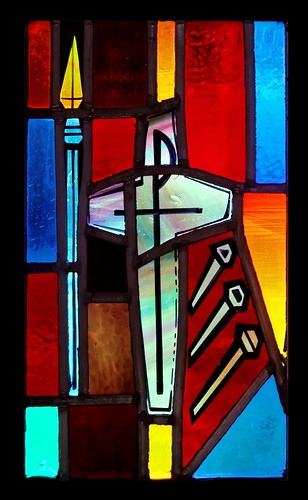

The nails and spear were not weapons
which Jesus used against others,
but He allowed them to be used
on Him for our redemption.

As a Minister of the Gospel, I know that I am potentially a target for some evil person who is angry at God and has some murderous intent. I knew when I took my ordination vows that I was dedicating my life in service to God and to God’s people in the congregation where I serve. I also knew that if society changed (as it is in the process of doing) that I would be a prime target for those who seek to harm the church through violence. I pray that such a thing does not come to pass, but if it does I pray that I would stand firm confessing Christ as my Lord and Savior without fear of death, nor of anything that man can do to me. Christ is risen from the dead, and has promised to bring me with Him into His heavenly kingdom as His redeemed child. “The Lord is with me; I will not be afraid. What can man do to me?” (Psalm 118:6)

There are some Biblical precedents for arming oneself for self defense and the protection of one’s neighbors. Abraham raised a small army and defeated several kings who kidnapped his nephew, Lot, and stole his property (see Genesis 14). Lot, and the others who were kidnapped with him were rescued and their belongings were restored. Also, in the Book of Esther, the Persian King who ruled over the Jewish captives in exile in Babylon, allowed the Jews to arm and defend themselves from those who sought to kill them. If you recall, the king had foolishly passed a law authorizing the killing of Jews, not realizing that his favorite wife, Esther, was a Jew. Even though the king was prevented by law from changing his foolish law, he issued another decree that the Jews could be well armed and fight to defend themselves against any who sought to destroy them (see Esther 8). This sounds like a recipe for civil war to have two opposing laws calling for violence, but it prevented a greater slaughter. The king also gave great honor to Esther’s uncle, Mordecai, who previously uncovered and foiled a plot against the king.


Jesus did not defend Himself
at His trial, even though
He was innocent.
He trusted in God to judge Him and vindicate Him.

Generally, God-fearing people ought to flee violence and seek peace, but there are times when such things are unavoidable. Psalm 34:14 says, “Turn from evil and do good; seek peace and pursue it.” Jesus also teaches that God-fearing believers ought to “turn the other cheek” when someone strikes you on the cheek (Matthew 5:39). Also Christ’s teaching in His “Sermon on the Mount” (see Matthew 5) shows that the Fifth Commandment (“You shall not murder”) also implies that we are to positively help support and protect our neighbor in his bodily needs, and not only refrain from murdering him.

Scripture doesn’t have a blanket command for self-defense, lest it be abused as an excuse to commit murder, but we are commanded to help protect our neighbor. As I mentioned above, I sometimes carry a knife, but I am not sure that I would use it to protect myself if I came under a threat. That could possibly seem to be self-serving, and just an excuse for murder, even though easily justified. I would, however, be much more inclined to use a knife or other weapon against someone who was attacking innocent people or those that I love, to protect their lives, if I was in a position to help in that way. Generally, though, I don’t view a knife as a weapon to be used against people. I am more likely to view it as a tool to open envelopes or packages or to cut things around the house or office that need cutting. Unlike a gun, a knife has many innocent uses around the home and the office. The only blood I have shed using knives is my own, when I have carelessly handled a sharp knife in one way or another. I hope never to see another’s blood by my own doing, whether for good or for ill.

I do not know if any of the members of my congregation bring a gun to church. If there are any who do, I would want to be assured that they are well trained and disciplined in its use. I would worry more that a child might accidentally get hold of someone else’s gun and hurt himself or others. However, if a gunman came into our church hell-bent on murder, then I would thank God for anyone who would put a stop to the murderous act. I don’t want any of the members of my congregation to kill anyone, unless they have to, but I would absolve the person who stopped a murderer, as long as it was clear that the murderer was the one who attacked first. Preemptive attacks on people who may or may not be contemplating violence are not justifiable, and are properly punished. Taking the life of someone is something that cannot be reversed, and should only happen if there is no other choice, like when a murderer is intentionally hurting innocent, unarmed people. There are consequences which affect the lives even of trained police officers and soldiers who must take the lives of others in the fulfilling of their duties. I would, without hesitation, comfort and absolve those who had to take someone’s life while protecting innocent lives and preventing more murder and injury.


Jesus said, “Blessed are the Meek
for they shall inherit the earth.”

King Solomon writes in Proverbs 16:7 “When a man’s ways are pleasing to the Lord, he makes even his enemies live at peace with him.” This happens because God’s law is good and for our benefit, and because God created us, He made us to benefit from His goodness and we are always better off when we keep to God’s law. If we love our enemies as God has loved us all, then even our enemies will have to acknowledge the righteousness of our actions, and they will no longer be our enemies, but our friends.
 
Saint Paul writes in Romans 12:18-21 “If it is possible, as far as it depends on you, live at peace with everyone. Do not take revenge, my friends, but leave room for God’s wrath, for it is written: ‘It is mine to avenge; I will repay,’ says the Lord. On the contrary: ‘If your enemy is hungry, feed him; if he is thirsty, give him something to drink. In doing this, you will heap burning coals on his head.’ Do not be overcome by evil, but overcome evil with good.” God is a truly impartial judge, and we are all accountable to Him in the end. If there is going to be punishment, we ought to leave it to God, or to His servants here on earth. God has established the proper authorities to punish wrongdoers, and to keep the peace. If we seek vigilante justice ourselves, we are almost certain to take it too far.
 
Hebrews 12:14 says, “Make every effort to live in peace with all men and to be holy; without holiness no one will see the Lord.” We cannot make ourselves holy, but if we aspire to be sanctified by God, the Holy Spirit, we ought to strive to be holy in all we do or say. This should be the guiding rule when it comes to self-defense. We should love our neighbor as we love ourselves (Leviticus 19:18). That means we ought to be hesitant to use violence against anyone unless it is absolutely necessary. Murderers are our neighbors, too, and if we can stop them without killing them, then they may be be brought to repentance and be saved. Jesus died to pay for the sin of murder, also. However, there is still temporal punishments for the sin of murder. After the great flood, God said to Noah, “Whoever sheds the blood of man, by man shall his blood be shed; for in the image of God has God made man.” (Genesis 9:6)


For further reading, see my December 2017 article on Anger.


Monday, August 17, 2015

Jesus is the True Bread of Life

by Pastor Paul Wolff


Not all who heard Jesus teach believed in Him


From this time many of his disciples turned back and no longer followed him. “You do not want to leave too, do you?” Jesus asked the Twelve. Simon Peter answered him, “Lord, to whom shall we go? You have the words of eternal life. We believe and know that you are the Holy One of God.”
(John 6:66-69)


In our culture it is commonly accepted that in order to win someone to your point of view that you must convince them in some way, and whatever you do – you must not offend them. Offense seems to be the considered the great “sin” in our society, and yet people have such thin skin that they take offense as often as they take a breath. This is because from a young age we have been influenced by the television and its advertisements. The purpose of ads is to motivate you to spend your money on a certain product or service, but the way they do this is often through the use of deception, manipulation, and lies. We are bombarded with these messages from a young age, so that we don’t even question it after a while. Because of this we are familiar with lies, and offended by the truth.

Jesus doesn’t work this way. Jesus gives a hard teaching to His followers, and they take offense, and they start to leave Him. But Jesus doesn’t try to stop them. He doesn’t try to convince them. He doesn’t say, “No, you misunderstand me, this is what I really meant …” Instead, he piles it on. He gives them more reason to take offense so that many who had been following Him turned back and no longer followed Him. Jesus wasn’t being mean in doing this, nor was He naïve or foolish. He was teaching the truth, but the truth can be hard to accept at times, but the truth is always better than a lie. After many people left Him Jesus then turned to His twelve disciples and said to them, “Do you want to go away as well?” Jesus wasn’t going to compromise the truth even for His closest disciples. If they found it too hard to accept then Jesus would drive them away, too.

Peter spoke for the disciples and said, “Lord, to whom shall we go? You have the words of eternal life.” The teaching of God’s Word is difficult, and it offends all of us at one time or another, because we are all sinners, and God’s Law condemns us for our sin – so we are offended. But God’s Word also teaches the Gospel which brings us salvation from our sin through the redemption which Jesus won for us. God’s word gives us eternal life! Are we going to take offense and turn away and run after something else which doesn’t give eternal life, or are we going to repent and trust in Jesus to save us?

What Jesus was teaching about which caused the people to take offense was food. Now you would not normally think that food would be a divisive topic, but you should remember that ever since the days of Moses the Israelites had lived under God’s ceremonial laws, which placed certain limits on the kinds of food that the people ate. For over a thousand years food was very much on the minds of the people, and what Jesus was teaching seemed to contradict that. Jesus was actually not contradicting the Old Testament dietary laws, He was fulfilling them!


Daily bread is a gift from God - even to all evil people

I assume that most of you have experience with food. Even if you were born yesterday you would still have one day’s experience with food. Food sustains life. It doesn’t give life, but food gives us the energy and nourishment to keep on living and to grow. Food is a necessity for us every day – or if you are like me, you may have stored up some extra food so that you can survive a day or two (or ten) without food.  

It is also a bonus that much of the food we eat also gives us pleasure. God has blessed us so that we can enjoy the food which sustains our life. It is a joy to eat a good meal. Though sometimes we can enjoy our food too much, so we must take our pleasure with food in moderation. If we use the pleasure we get from food to try to make up for some pain or sadness, then we can overindulge and then the food which ought to sustain our life can also damage it. Good food is a gracious gift from God, so enjoy your food, and thank God for it, but be careful not to overdo it.

But we need to remember that the food we eat does not give life, it only preserves it. No earthly food can keep you alive forever. There is no “fountain of youth”. If you watch the advertisements on TV without a discerning eye you might be led to believe that there is a certain food or medicine which can prolong your life indefinitely, if not make you live forever. However, it is not true. Even if there was a perfect food which provided all your needs and did not poison you, you would still die. Death comes as a result of sin, and sin is a disease which affects us all. You can have the perfect diet and exercise habits, and you will still die. That is our greatest problem.


Jesus is the True Bread from heaven

But, Jesus is the solution to our problem of sin and death. Jesus said, “I am the living bread that came down from heaven. If anyone eats this bread, he will live forever. This bread is my flesh, which I will give for the life of the world.” (John 6:51) Jesus is the bread of life, and He doesn’t just sustain our life of sin, instead Jesus gives us life without sin and death. Christ’s flesh is the bread of life because He sacrificed His flesh and blood to pay the price for our sin so that He could redeem us and give is eternal life. Jesus also said, “Unless you eat the flesh of the Son of Man and drink His blood, you have no life in you. Whoever eats my flesh and drinks my blood has eternal life, and I will raise him up at the last day.” (John 6:53-54)

Well, maybe you can begin to see why the Jews were upset about Christ’s teaching. Jesus had not yet instituted the Lord’s supper, so they didn’t know what the Sacrament was all about, but then even today when we have the clear teaching of Scripture, many Christians still don’t understand (or don’t believe) what the Lord’s Supper is all about. Eating a man’s body sounds like cannibalism, which God has always forbidden. Jesus was not talking about cannibalism, but He does give us His flesh and blood for eternal life. When a cannibal eats a person he cannot do it without causing great bodily harm to his victim, and he doesn’t receive the whole person, but only a part; and it doesn’t give him life any more than eating an animal, so he treats his neighbor no better than an animal. These are all reasons why God forbids cannibalism, and condemns it as a terrible sin.

However, when Jesus gives us His body and blood to eat and drink in the Lord’s Supper it is not like cannibalism – but not for the reasons you may have heard. Some unbelievers say that the Lord’s Supper is just a symbolic act – that the communicants don’t really receive the Body and Blood of Jesus. That is not true. Jesus said, “This is my body” and “This is my blood”. That is what He gives to us in the Lord’s Supper. But in the Sacrament we don’t just get a part of Jesus – we get all of Him. And though we eat His body and drink His blood, He is not harmed by this at all. Yet we get blessings far greater than any other food we may eat.


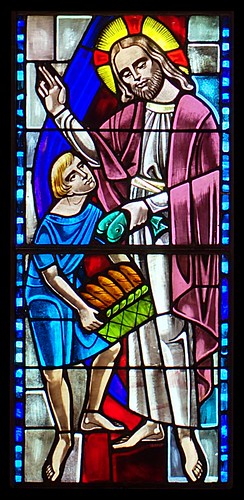
Jesus fed 5,000 people with 5 loaves of bread
and 2 fish with 12 full baskets left over
after everyone had eaten their fill.

The Jews asked themselves, “How can this man give us his flesh to eat?”, but this is the wrong question. Jesus is God incarnate. Jesus fed 5,000 people with 5 loaves of bread and 2 fish, and when everyone had eaten their fill collected 12 baskets of leftovers. If Jesus desires to give His whole body and blood to each of the two billion Christians in the world who each only eat a small morsel of unleavened bread and drink a small sip of wine, then He can do it. Are we going to doubt Jesus – who died and rose to life again? “To whom shall we go? {Jesus} is the Word which gives us eternal life!”

If you find this hard to understand you should take comfort in knowing that no one can really understand this fully. It is a miracle from God – who can understand it? Yet though we do not understand it, we trust the clear words of Jesus that He gives us this great gift for our blessing. For our forgiveness and eternal life.

However, although everyone who eats the Lord’s Supper receives the Body and Blood of Jesus in the bread and wine, not all receive the blessings. Only those who believe the words of Jesus receive the blessings of forgiveness and eternal life. How this works is that those who believe receive the gift of Jesus and hold on to Him by faith, and never let Him go, and so receive the blessings. But when an unbeliever receives the Body and Blood of Jesus he denies the truth of what he has received and he rejects it and throws it away as if it were no more than a small piece of bread and a sip of wine.

This is one reason why the vast majority of Christian churches throughout history and even now throughout the world practice closed communion. In 1 Corinthians 11:27-30 St. Paul instructs the Corinthians saying,
Therefore, whoever eats the bread or drinks the cup of the Lord in an unworthy manner will be guilty of sinning against the body and blood of the Lord. A man ought to examine himself before he eats of the bread and drinks of the cup. For anyone who eats and drinks without recognizing the body of the Lord eats and drinks judgment on himself. That is why many among you are weak and sick, and a number of you have fallen asleep.
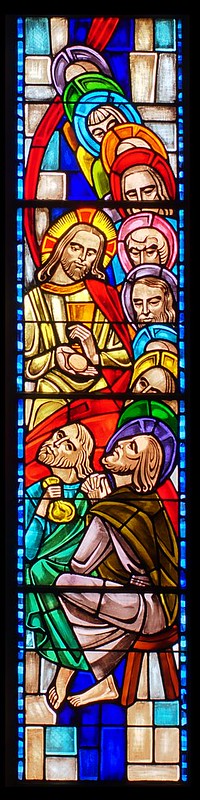
Jesus gives us His body and blood
in the bread and wine of the Sacrament
for our forgiveness and eternal life.

We eat and drink unworthily if we do not believe. The Lord’s supper is for sinners, but only for those who believe, and those who share a common confession. We don’t commune with Baptists, or Roman Catholics, or heretical Lutherans, (for example) because we do not agree with their false teachings – even though there may be true Christian believers in all these churches. But we don’t want to give people the impression that we agree with false teaching.

The Reformed churches (Calvinist and Arminian) practice open communion because they do not believe the words of Jesus, and they also ignore Saint Paul’s warnings that “anyone who eats and drinks (the Lord’s Supper) without recognizing the body of the Lord eats and drinks judgment on himself.

These are hard teachings. Perhaps you who are reading this doubt the clear teachings of Scripture because you think they are too hard to believe. Are you considering turning away and going somewhere else? To whom shall you go? These are the teachings of Jesus which bring eternal life. You may find teachers which are easier to hear, but they will not give you eternal life which is the true bread from heaven, Jesus Christ.

If you do not believe the words of Jesus you should refrain from receiving the Sacrament – at least until you can study the Scriptures and see that this is the true teaching of Christ for your salvation.

It is hard to trust the words of Jesus. No one can believe unless the Holy Spirit gives faith, but He works through the Word to give you that faith so that you may believe and that you may find your salvation in Jesus Christ. Only Jesus gave His life as a payment for your sins. Only Jesus comes to you in His sacraments to forgive your sins and give you eternal life. May God, the Holy Spirit, strengthen your faith so that you may say with St. Peter, “Lord, to whom shall we go? You have the words of eternal life.”


For more on a similar topic see: Was Jesus Unloving?


Wednesday, December 29, 2010

“Let His Blood be on Us and on Our Children”

by Pastor Paul Wolff

From Zion Lutheran Church, Columbus, Ohio
(Matthew 27:15-26)
Now it was the governor’s custom at the Feast to release a prisoner chosen by the crowd. At that time they had a notorious prisoner, called Barabbas. So when the crowd had gathered, Pilate asked them, “Which one do you want me to release to you: Barabbas, or Jesus who is called Christ?” For he knew it was out of envy that they had handed Jesus over to him.

While Pilate was sitting on the judge’s seat, his wife sent him this message: “Don’t have anything to do with that innocent man, for I have suffered a great deal today in a dream because of him.”

But the chief priests and the elders persuaded the crowd to ask for Barabbas and to have Jesus executed.

“Which of the two do you want me to release to you?” asked the governor.

“Barabbas,” they answered.

“What shall I do, then, with Jesus who is called Christ?” Pilate asked.

They all answered, “Crucify him!”

“Why? What crime has he committed?” asked Pilate.

But they shouted all the louder, “Crucify him!”

When Pilate saw that he was getting nowhere, but that instead an uproar was starting, he took water and washed his hands in front of the crowd. “I am innocent of this man’s blood,” he said. “It is your responsibility!”

All the people answered, “Let his blood be on us and on our children!”

Then he released Barabbas to them. But he had Jesus flogged, and handed him over to be crucified.


Even before Mel Gibson’s movie, “The Passion of the Christ” came out in 2004 he received complaints from Jewish groups about the scene where the Pharisees exerted their political pressure on Pontius Pilate to have Jesus crucified. The modern Jewish groups claimed that the words of the Pharisees from Matthew 27:25, “Let his blood be on us and on our children!” would incite anti-Jewish behavior from viewers. Mel Gibson at first tried to alleviate their concerns that he was targeting them for ridicule by saying, “I’ve never met a Pharisee.”

That response was not sufficient because one need not know much history to make the spiritual connection between the modern Jewish religion and their roots in ancient Rabbinical Phariseeism. After further complaints Gibson compromised by removing the captions which read, “Let His blood be on us and on our children” though he left the Aramaic dialogue (for those who understand Aramaic.)


The Crucifixion of Jesus
It is one of many ironies about this scene from the Gospel story that in trying to distance themselves from the ancient Pharisees the modern Jewish groups actually connect themselves very strongly with their ancient forebears. Although the Pharisees were willing and eager to take responsibility for the death of Jesus and the modern Jews are not, both groups are motivated by the same theology, which is that both the ancient Pharisees and the modern Jews reject Jesus as their Messiah.

There is, however, one group of people around today who is willing to take responsibility for the death of Jesus: Christians.

Unlike modern Jews, Christians are not ashamed to say of Jesus, “Let his blood be on us and on our children!” and mean it in every sense of the phrase, including the sense that Jewish groups are so afraid of. The Holy Scriptures explain very well how we are responsible for the death of Jesus and how the blood of Jesus redeems us from our sins:
  • “The blood of Jesus [God’s] Son cleanses us from all sin.” (1 John 1:7)
  • “Do you not know that all of us who have been baptized into Christ Jesus were baptized into his death? … If we have been united with him like this in his death, we will certainly also be united with him in his resurrection.”(Romans 6: 3, 5)
  • “Who are these, clothed in white robes, and from where have they come? … These are the ones coming out of the great tribulation. They have washed their robes and made them white in the blood of the Lamb.” (Revelation 7:13-14)

Christians regularly publicly proclaim that they are both individually and corporately responsible for the death of Jesus. We do this every time we celebrate the Lord’s Supper, and every time we have a public confession of sins. In the New Testament St. Paul teaches the Corinthian Christians about the Lord’s supper saying, “Is not the cup of thanksgiving for which we give thanks a participation in the blood of Christ? And is not the bread that we break a participation in the body of Christ?” (1 Corinthians 10:16) The Lutheran Confessions use this verse to show that the body and blood of Christ is truly present in a bodily way in the sacrament. Jesus gives us His body and blood for the forgiveness of our sins and for the strengthening of our faith. St. Paul goes on to teach in 1 Corinthians 11:26, “For whenever you eat this bread and drink this cup, you proclaim the Lord’s death until he comes.” In proclaiming the Lord’s death we are not just saying, “it happened,” but “it happened on account of my sins, and for my salvation.” Jesus wants us to confess our sins so that we might also receive full forgiveness and salvation, so we are bold to admit our complicity and guilt in the death of Jesus. Jesus doesn’t hold our sins against us, but gives everlasting life to all who trust in Him as their savior from sin.

Jesus prayed, “My Father,
if it is possible, may this cup be
taken from me. Yet not as I will,
but as you will.” (Matthew 26:39)

There is also another teaching in Scripture which would deflect the so-called “blame” for Jesus’ death away from not only the Jewish Pharisees, but also the Gentiles. In John 10:17-18 Jesus Himself says, “The reason my Father loves me is that I lay down my life – only to take it up again. No one takes it from me, but I lay it down of my own accord. I have authority to lay it down and authority to take it up again.” This is shown in the Gospels by the fact that several times people tried to kill Jesus, but until He had completed His work He wouldn’t allow them to lay a hand on Him. The first time this happens is soon after Jesus is born and King Herod sends his troops to Bethlehem to kill Jesus along with all the baby boys in the town. The last time this happens is in the garden of Gethsemane when the soldiers come to arrest Jesus. Before Jesus allows the soldiers to take Him He causes all of them to fall on the ground simply by saying the words “I am” (see John 18:1-11 especially v. 6). Jesus did this to demonstrate that He wasn’t overpowered, but that He went willingly.

This is not to say that we are guiltless. We are all guilty. Our sin makes us enemies of God, and by our very nature we all wish to kill God and put ourselves in His place of power and authority. This is what we do whenever we commit actual sins. When we sin we are exerting our own sinful will against God and trying to push Him out of the way. God knows this very well. In fact, this is the very reason God became incarnate in Jesus Christ in the first place. God knew how hopeless our sinful situation was from before the beginning, so He decided to take care of our salvation Himself and that is just what Jesus did in His life and in His death. This is why Christians are not afraid to both confess our guilt in the death of Jesus, and also to confess our faith that because of His death and resurrection from the dead Jesus has forgiven us all our sins and will give eternal life to all who trust in Him.

***
Note: Although I used Mel Gibson’s movie and the surrounding objections as an illustration for this essay I am not unaware of the subsequent accusations of bad behavior on the part of Mr. Gibson. Whether Mel Gibson is anti-Semitic or not is irrelevant to this issue. The scene in question from the “Passion” movie is an accurate representation of the Gospel account from Matthew and neither the scene nor the Gospel of Matthew is anti-Semitic. Even if it turns out to be true that Mel Gibson has sinful feelings against Jews it does not come out in “The Passion of the Christ.” This is proven by the symbolism of Gibson’s cameo appearance in the movie. When Jesus is shown being nailed to the cross it is Mel Gibson’s hands which pound the nails into the hands of the Jesus character. This was Gibson’s way of saying (along with all Christians) “I am responsible for the death of Jesus. My sins caused the death of Jesus, but His death redeemed me of all my sins.”

For further reading: Matthew 27:15-26; 1 Corinthians 10:14-17; 1 Corinthians 11:23-26; Revelation 7:13-17; Romans 6:1-10; Hebrews 9:11-28; 1 John 1:5-10.

See also my 2004 newsletter article,
“The Passion of Christ”