Showing posts with label incarnation. Show all posts

Sunday, August 20, 2017

How Far does God go to Keep His Promises?

(and promises made in His name)
by Pastor Paul Wolff
 
David playing the harp

There is an odd little story in 2 Samuel 21 about God sending a famine against the Kingdom of Israel in the days of King David. What is strange is that by this time the Kingdom is pretty well established, and seemingly out of nowhere, God is punishing His people with an extended famine. When David asked God what was the reason for the famine, God answered that this was in response to something King Saul had done. What Saul had done was to attempt to destroy the Gibeonites, who were an Amorite people living in the land since before the days of Joshua.

The beginning of the story is found in Deuteronomy 7:1-6 in the days of Moses. God tells Moses and the Israelites that when He brings them into the land He had promised to Abraham and his descendants, they are to completely destroy all the peoples living there, including the Amorites and others. The Israelites were not to intermarry with them, nor make any treaty or covenant with them, but they must devote them to complete destruction. The peoples of Canaan were idolaters, and the Israelites were to completely destroy their altars and places of worship lest they fall into idolatry and come under God’s curse themselves (which they did from time to time.) God was very clear in His instructions about how they ought to deal with the people of Canaan.
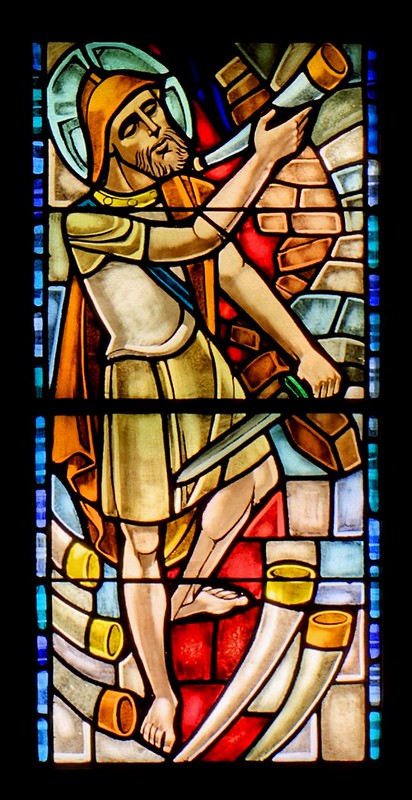
Joshua made a treaty in God's name
with the Gibeonites

Many years later, in the days of Joshua (see Joshua 9), the inhabitants of Gibeon heard that the Israelites had destroyed Jericho and Ai and they feared that they soon would be next. They devised a plan to trick the Israelites to make a treaty with them and not destroy them. The Gibeonites sent a delegation to Joshua dressed in old worn out clothes and shoes. The bread they had with them was dry and moldy, and their wine-skins were old and patched. They said they were from a very distant country and wanted to make a treaty with the Israelites. They said that when they left their home their bread was fresh out of the oven, and their wine-skins and shoes were new. The Israelites sampled their provisions, but they did not seek the counsel of the Lord. Joshua made a covenant with them and swore in the name of the Lord to let them live.

Three days later, Joshua heard that the Gibeonites were their neighbors. The Israelites did not attack them, because of the oath that they made not to harm them, but they summoned their leaders and said, “Why did you deceive us?” The Gibeonites were very gracious, and humbled themselves before Joshua and the Israelites. They told of how they had heard how God had commanded Moses to destroy all the inhabitants in the land, and they feared for their lives. They said, “We are your servants, do whatever seems good and right.” Joshua cursed the Gibeonites to be the servants of the Israelites, being woodcutters and water bearers, but he honored the treaty he made with them and let them live. For their part, it seems that the Gibeonites were just glad to escape God’s judgment on the Canaanites, and they lived at peace with the Israelites and did not betray their part of the treaty.

The Israelites also kept their part of the treaty until King Saul tried to destroy the Gibeonites. Another strange part of this story is that Saul’s part in this story is not found elsewhere in Scripture. Apparently the chronicler who wrote the Book of Samuel did not think this particular misdeed of Saul’s was an important part of the story in a chronological telling, and he did not mention it until he wrote of God bringing the famine in 2 Samuel 21. David, however, knew the history (or looked it up in Scripture), and called the surviving Gibeonite leaders and said, “What shall I do for you to make atonement that you may bless the Lord’s inheritance?”
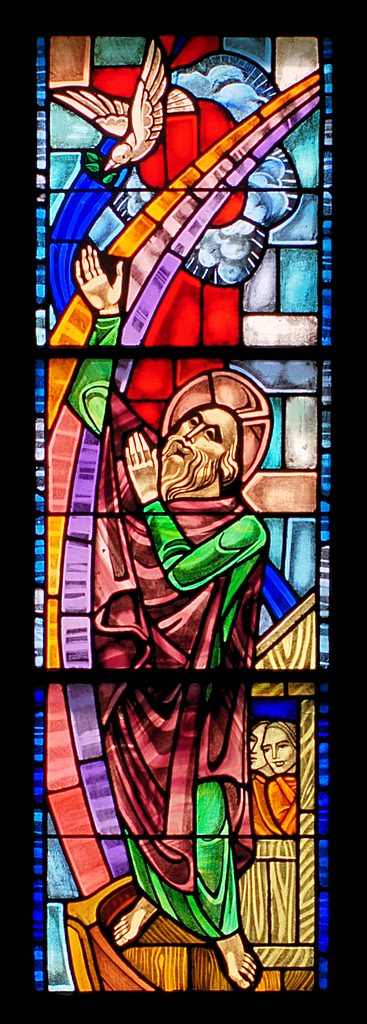
The rainbow is God's sign to Noah that He would not
destroy the earth again with a flood even though
the thoughts of man are only evil all the time.
Genesis 6:5 and 8:21

The Gibeonites were still very humble and submissive before King David, as their ancestors had been hundreds of years earlier with Joshua, and hesitated to make demands to the King, but David repeated, “What shall I do for you?” They asked that seven of Saul’s remaining male descendants would be given to them to be put to death for justice for all the Gibeonites that Saul killed. David agreed to their terms, but he spared Mephibosheth, the son of Jonathan, because of the friendship he had with the son of King Saul. God honored this agreement and lifted the famine.

All of this begs the question: Why would God go to such great lengths to punish Israel for Saul’s misdeeds, many years after Saul had died, on behalf of a people whom He had condemned for destruction hundreds of years earlier, for the sake of a treaty Joshua had made against God’s command? The answer is that God keeps His promises. Or, in this case, God honors the promises made by His people in His name and on His behalf. Despite the fact that God had intended for the Gibeonites to be destroyed with all the inhabitants of Canaan, Joshua had sworn an oath in God’s name that the Gibeonites would not be harmed by the Israelites, and when Saul broke that treaty, God allowed the Gibeonites restitution for the sake of justice, and the honor of God’s name.

If God would go to these great lengths to keep this promise made in His name, even though He never wanted it in the first place, then what does this say about how God will regard His other promises? It shows that God can absolutely be trusted to keep all His promises, no matter what happens.

The very day that Adam and Eve sinned
God promised to send a savior
who would rescue them from their sin.

The main promise that God fulfilled was the promise He made to Adam and Eve when He cursed the serpent in Genesis 3:15. God promised to send the seed of the woman to crush the serpent’s head, though the serpent would bruise his heel. God remembered this promise, even though he destroyed the evil people in the days of Noah, but he saved Noah and his three sons, and each man’s wife (eight people). Likewise when Israel had turned against God and refused to listen to the prophets calling for repentance, God destroyed the ten northern tribes, and nearly wiped out the kingdom of Judah, but He saved a remnant among whom were the descendants of King David who would be the ancestors of Jesus. Jesus is the fulfillment of God’s greatest promise. He is a descendant of Adam and Eve through His mother, Mary, and conceived miraculously by the work of the Holy Spirit, Jesus is God incarnate, who paid for the sins of the world with His perfect obedience, and His innocent suffering and death in our place on the cross.

Compared with the Incarnation of God in Jesus, and the redemption He won for our forgiveness and salvation, the incident with the Gibeonites is of little consequence, but it shows that God honors His promises, and He can be trusted to remain faithful in big promises, and small.

We all ought to see ourselves in a similar situation as the Gibeonites. As the Gibeonites were condemned to destruction for their idolatry, so we are condemned to destruction for our idolatry and other sins. As Joshua promised to spare the Gibeonites, so the greater Joshua (the name “Jesus” is the Greek version of the name, Joshua, meaning, “savior”) has promised to spare us from the punishment due us on account of our sin, because He paid the price and satisfied God’s wrath by dying in our place.
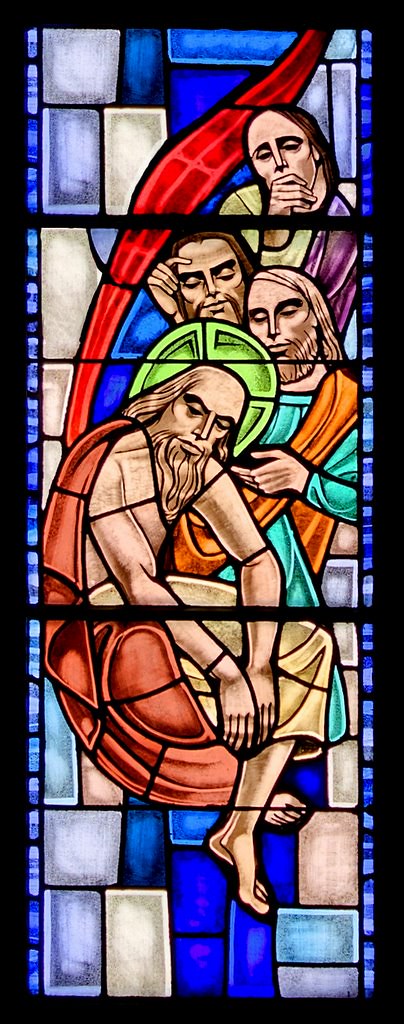
Job’s friends were no comfort when they
misrepresented God’s promises.
Worldly wealth is not a sign of God’s favor,
and poverty is not a sign of God’s disfavor.

Christians ought to be careful when their preachers or anyone make claims about the things God has promised. False teachers make claims about God’s promises which are not true. For example, the “prosperity gospel (sic)” heretics will tell you all day long that you will be rich and successful. However, just because God blessed Abraham and Job with great riches, that doesn’t mean that you will be likewise blessed. God could ask you to suffer like Job, or it is possible that you life may be like the beggar, Lazarus, in the Parable of the Rich Man and Lazarus. Our reward is in heaven, not on earth. Always check your pastor’s claims against the Holy Scriptures. Even when your pastor quotes the Scriptures, double check the context of the passages which are being quoted, to make sure they really say what is being claimed. This goes for my parishioners, too. We all ought to be like the Berean Christians in Acts 17:11 who examined the Scriptures daily to see that the things that Saint Paul was preaching were true. (They found that indeed, he was preaching the truth. Jesus is the promised savior that the Old Testament foretold.)

Here is a sampling of a few of God’s promises which we can rely upon:

Hebrews 13:5-6 says, “Keep your life free from love of money, and be content with what you have, for (God) has said, ‘I will never leave you nor forsake you.’ So we can confidently say, ‘The Lord is my helper; I will not fear; what can man do to me?’” God will never leave us, though, in His mercy, He remains hidden from our senses. This is a matter of faith, but since we can trust in God’s promises we can trust that it is true even (and especially) when it seems like we are alone and abandoned. This passage quotes from several places where it is repeated in the Old Testament. Some common sources are Deuteronomy 31, Psalm 37, and a couple phrases in Isaiah 41 also teach this.
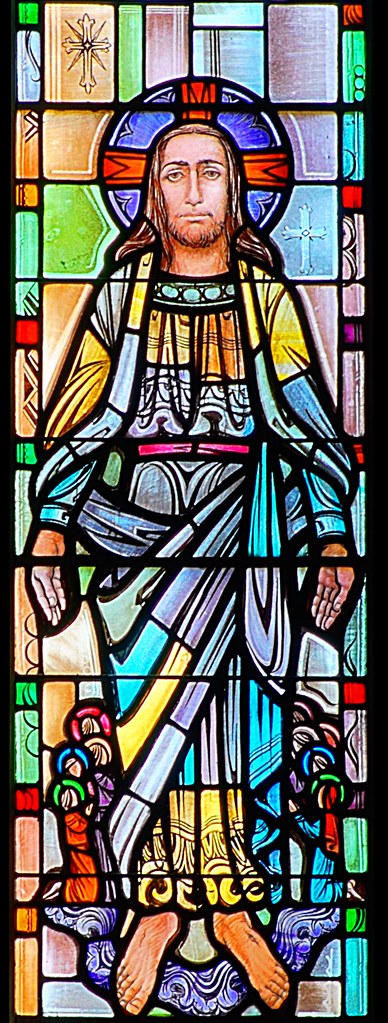
Jesus said, “I am with you always,
to the end of the age.”

Jesus also repeats this at His final teaching before His ascension into heaven. In Matthew 28:20 Jesus says, “Behold, I am with you always, to the end of the age.” This is a great comfort especially when it seems like God is far away from us and the world is falling apart around us.

More of Christ’s promises are found in Matthew 10:32-42 where Jesus said, “Everyone who acknowledges me before men, I also will acknowledge before my Father who is in heaven, whoever denies me before men, I also will deny before my Father who is in heaven. Do not think that I have come to bring peace to the earth. I have not come to bring peace, but a sword. For I have come to set a man against his father, and a daughter against her mother, and a daughter-in-law against her mother-in-law. And a person’s enemies will be those of his own household. Whoever loves father or mother more than me is not worthy of me, and whoever loves son or daughter more than me is not worthy of me. And whoever does not take his cross and follow me is not worthy of me. Whoever finds his life will lose it, and whoever loses his life for my sake will find it. Whoever receives you receives me, and whoever receives me receives him who sent me. The one who receives a prophet because he is a prophet will receive a prophet’s reward, and the one who receives a righteous person because he is a righteous person will receive a righteous person’s reward. And whoever gives one of these little ones even a cup of cold water because he is a disciple, truly, I say to you, he will by no means lose his reward.” This is a comforting passage in times of antagonism and persecution, when the world turns against us and tries to get us to deny the forgiveness and salvation we have in Christ, our Lord. The world wants us to consider that they are gods and to worship and honor them, as they worship and honor themselves and others. There is no salvation there, but only in Christ Jesus. Jesus promises us persecution, but when we remember that He is always with us, and that He will honor a faithful confession in His heavenly Kingdom, then we can stand against the world even if we otherwise stand alone. Christ will have the final word on Judgment day, when He will bring His people with Him to live with Him forever in glory.

Wednesday, December 25, 2013

The Incarnation of God

by Pastor Paul Wolff

The Incarnation of God in Jesus is one of the greatest mysteries in all of history. Yet, we ought to remember that whenever the Holy Scriptures speak of a mystery it is something that has been revealed to us in Jesus. It is not that all our questions are answered, but the great mysteries are no longer hidden, but are revealed in Jesus.

“In the past God spoke to our forefathers through the prophets at many times and in various ways, but in these last days he has spoken to us by his Son, whom he appointed heir of all things, and through whom he made the universe. The Son is the radiance of God’s glory and the exact representation of his being, sustaining all things by his powerful word.” (Hebrews 1:1-3)

When the Angel Gabriel said to the virgin, Mary, “You will be with child and give birth to a son, and you are to give him the name Jesus…” God was then incarnate in a microscopic single celled person, Jesus. He was still God, but He humbled Himself and from the moment of His conception He lived a life just like the rest of us, except without sin.

It should be little wonder that “the world did not recognize Him” (John 1:10) because in His humility Jesus did not use His Divine power until his ministry began. Jesus had to learn who He was, and why He came to earth to live as one of His beloved creatures. And yet, even though Jesus had to learn and grow like any other child, He still lived the sinless life according to His nature. Even though Mary and Joseph surely sinned against Him (how could they not?), and even though His siblings: James, Joseph, Judas, Simon, and his sisters (Mark 6:3); surely sinned against Him, yet Jesus never sinned against them, nor against God, the Father.

Window from Trinity Lutheran Church, Herscher, Illinois
It is a good exercise to consider all that Jesus sacrificed in order to save us. Though we cannot know all that Jesus sacrificed, the better idea we have of what He sacrificed, the better we can appreciate what He did to save us from our sin and death.

Pastor Jared Melius of Mt. Zion Lutheran Church, Denver, Colorado, has some great insight into Luke 2:41-52 (Issues Etc. audio link) which shows just how much Jesus gave up to win our salvation. This story is not about Christ’s Nativity, but it happened when He was 12 years old. Sometimes this event is described as the boy Jesus teaching in the temple, but that is not the way Luke records the event. Pastor Melius’ brilliant insight is that although Mary and Joseph regularly went to Jerusalem for the Passover this may have been Jesus’ first time there since He was 40 days old (Luke 2:22-ff). Jesus did not come to teach, but to learn, as Luke makes a point of saying how Jesus grew as a child.

Since it was the Passover celebration, Jesus likely asked questions about the sacrifice of the passover lamb, and how it saved God’s people from the plague of death, and how the death of the lamb related to the promised messiah. He learned from the Scriptures that God’s messiah would sacrifice His life like a passover lamb to save all people from their sins. In His state of humility, Jesus had to learn that it was the will of God, the Father, that He would give up His life to save sinners from the consequences of their sins. And yet, Jesus did not once turn away from the path that God, the Father, had placed before Him.

The Holy Scriptures were not written only for us sinners, that we may believe in Christ as our savior, but they were also written for Jesus, so that He might also know what He had to do in obedience to God to win our salvation. Jesus, too, had to trust in God’s Word, and obey God as a man, even though it meant great suffering and torment for Him. Out of His love for God and for us sinners, Jesus obeyed His Father and was obedient unto death, even death on a cross (Philippians 2:5-11)!

May Christ bless you and your family through the Christmas Season and throughout the whole year as you contemplate God’s incarnation, and all that Jesus did to save you from sin and death!


Wednesday, December 10, 2008

Hard to Believe

The Annunciation - from Emmanuel

In the sixth month, God sent the angel Gabriel to Nazareth, a town in
Galilee, to a virgin pledged to be married to a man named Joseph, a descendant of David. The virgin’s name was Mary. The angel went to her and said, “Greetings, you who are highly favored! The Lord is with you.”

Mary was greatly troubled at his words and wondered what kind of greeting this might be. But the angel said to her, “Do not be afraid, Mary, you have found favor with God. You will be with child and give birth to a son, and you are to give him the name Jesus. He will be great and will be called the Son of the Most High. The Lord God will give him the throne of his father David, and he will reign over the house of Jacob forever; his kingdom will never end.”

“How will this be,” Mary asked the angel, “since I am a virgin?”

The angel answered, “The Holy Spirit will come upon you, and the power of the Most High will overshadow you. So the holy one to be born will be called the Son of God. Even Elizabeth your relative is going to have a child in her old age, and she who was said to be barren is in her sixth month. For nothing is impossible with God.”

“I am the Lord's servant,” Mary answered. “May it be to me as you have said.” Then the angel left her. (Luke1:26-38)


When writing about the Annunciation of the incarnation of the Son of God, Dr. Martin Luther (1483-1546) quoted St. Barnard who said, “there are here three miracles: that God and man should be joined in this Child; that a mother should remain a virgin; that Mary should have such faith as to believe that this mystery would be accomplished in her.” Luther then noted, “The last is not the least of the three.”

Martin Luther certainly didn’t mean to say that Mary did something miraculous, but rather that the faith that God gave her to believe this amazing event was at least equal to the miracle of the incarnation. The High Priest, Zechariah, could not believe a slightly lesser miracle when the angel Gabriel brought him the news that he would have a son with his elderly wife (Luke 1:18). Mary, likewise, couldn’t understand how it could be that she would conceive a son as a virgin, but she believed the Word of God spoken through His messenger.

The incarnation of the Son of God into human flesh is truly THE turning point in all of history. That is why we count our years from the culmination of this event, the birth of the baby Jesus. Or I should say, we count our years from the date of Christ’s birth that was calculated to the most likely date when the Gregorian calendar was put together. Newer research suggests that Jesus was actually born in 4 or 3 B.C., but after 1,975 years (or so, as I write this) a few years doesn’t matter to me either way. The point is that we count our years from the birth of Jesus (more or less).

When God became a man with the conception of Jesus it was the fulfillment of God’s promise to Adam and Eve that the woman’s seed would come to crush the wicked serpent which led them into sin and death. It was a promise that God had repeated and reconfirmed throughout history so that faithful people would not lose hope and despair.

The incarnation is such a wonderful, and important event, that it has been attacked by many throughout the succeeding years. Ulrich Zwingli (1484-1531) maintained that “the finite cannot contain the infinite.” He was referring to the bodily presence of Christ in the Sacrament of the Lord’s Supper, but if it isn’t true for the Sacrament, it can’t be true for the incarnation. Fortunately, Zwingli was wrong. Scripture says in Colossians 1:19 that “God was pleased to have all his fullness dwell in Him (Jesus).” Even from the moment of conception, when Jesus was just a one-celled person, He was still in control of all creation as God. Yet, as an infant, He was still dependent on His mother (and soon-to-be stepfather, Joseph) for protection, nourishment, and other physical care.

Now, when I say that it was a miracle that Mary believed in the Virgin Birth I don’t mean to say that the story is a myth and that it didn’t really happen. Both of the Gospel accounts in Matthew and Luke tell a story that is rich in detail as if it were true and not a myth or fantasy or fiction. If we only listen to the story in Christmas carols or as told to little children then we may think it was a myth. However, note how Matthew tells the story: “This is how the birth of Jesus Christ came about: His mother Mary was pledged to be married to Joseph, but before they came together, she was found to be with child through the Holy Spirit. Because Joseph her husband was a righteous man and did not want to expose her to public disgrace, he had in mind to divorce her quietly. But after he had considered this, an angel of the Lord appeared to him in a dream and said, ‘Joseph son of David, do not be afraid to take Mary home as your wife, because what is conceived in her is from the Holy Spirit. She will give birth to a son, and you are to give him the name Jesus, because he will save his people from their sins.’”(Matthew 1:18-20)

It is interesting to note that God did not send the message to Joseph at the same time He told Mary. God let Mary explain the situation to Joseph first. Though Matthew doesn’t tell us all of the discussion between Mary and Joseph you know that they had to have had a heated discussion, and there must have been many tears shed. It is not easy to believe in a miracle which had never happened to that point in history (though some may have claimed that it had). The way that Matthew describes Joseph’s thinking shows that he didn’t believe Mary’s explanation of the miracle. Joseph had determined to divorce Mary, though quietly so as not to expose her to “disgrace.” What had happened to Mary was as far from a “disgrace” as you can get for a sinful human, but it was not easy to believe.

The virgin birth of Jesus is still not easy to believe. In fact, it is impossible to believe. That is what faith is all about. Faith is about believing what seems impossible. This is why unbelievers have the wrong impression that faith is “blind,” not to mention “ignorant” and “foolish.” True faith is a gift from God, and just like Mary’s belief that God would conceive a child in her with her virginity intact, it is always a miracle.

A greater miracle than the virgin birth of Jesus is the fact that God would become a man in order to save His rebellious people from their sins instead of punishing sinners as they deserve. This is truly the core of the Christian faith and the heart of the Gospel. No other god on earth would do such a thing because all other gods are fictitious creations from the mind of men, and no one could imagine a god who would do such a thing. But that is exactly what God did in Jesus Christ. For this we remember the birth of Jesus as the most important turning point in all of history. When Jesus came to us God was accomplishing our salvation as He had first promised the very same day that sin came into the world.

Monday, December 1, 2008

Don’t make me come down there!

From Emmanuel

This is how the birth of Jesus Christ came about: His mother Mary was pledged to be married to Joseph, but before they came together, she was found to be with child through the Holy Spirit. Because Joseph her husband was a righteous man and did not want to expose her to public disgrace, he had in mind to divorce her quietly.

But after he had considered this, an angel of the Lord appeared to him in a dream and said, “Joseph son of David, do not be afraid to take Mary home as your wife, because what is conceived in her is from the Holy Spirit. She will give birth to a son, and you are to give him the name Jesus, because he will save his people from their sins.”

All this took place to fulfill what the Lord had said through the prophet: “The virgin will be with child and will give birth to a son, and they will call him Immanuel” --which means, “God with us.” (Matthew 1:18-23)


A couple years ago there was a well-intentioned, but ultimately blasphemous billboard campaign which purported to be some kind of messages from God. They showed a black billboard with white lettering ending in the simple tag, “– God.” It was blasphemous because none of the pithy sayings had any direct reference to Holy Scripture, and they only contained Law and no Gospel, and they frequently contradicted clear teachings of God’s word. Nevertheless, they were sort of amusing in a superficial (though blasphemous) way. One of my favorites said, “Don’t make me come down there. – God” as if God were a parent warning His disobedient children with vain threats.

I don’t know what the billboard writers had in mind because they were a little late with their warning. The first people that God created (Adam and Eve) long ago let that cat out of the bag. Because Adam and Eve brought sin into the world God DID come down here. Fortunately, when God came down here He didn’t bring about the punishment the billboard sponsors were insinuating. When God came down here He didn’t come to judge and condemn us. Instead God came down to rescue and redeem us from our sinfulness.

This is the Gospel message. It is also one reason why our church is named Emmanuel and it is why the windows pictured with this essay are right up front and are a prominent visible feature to all who worship in our church.

The incarnation of God into man is the central event in all of human history. That is why we count our years from the date of Christ’s birth (or as close as could be determined at the time, but that is a story for another blog). God knew before He made people that we would rebel against Him and we would be lost unless He did something to save us. Yet, He went ahead and created the people who would reject His authority and cause Him immense grief and suffering. Why would anyone do that? Only love could cause someone to go through that kind of suffering rather than avoid it. “Very rarely will anyone die for a righteous man, though for a good man someone might possibly dare to die. But God demonstrates his own love for us in this: While we were still sinners, Christ died for us.” (Romans 5:7-8)

All man-made gods require something from their followers to prove that they are worthy of favor. This makes these false gods seem very demanding, but it also makes them able to be manipulated by the actions of people. This is why false gods are so attractive to people. Though the false gods can be harsh taskmasters, they can also make it seem to the people as if they can control God. This is what people have been trying to do ever since Adam and Eve first disobeyed God in the Garden of Eden.

The true God is not like the false gods. Jesus didn’t come to us to demand anything from us. There is nothing we can give God that doesn’t already belong to Him. We can’t make up for our sinful rebelliousness. Jesus didn’t come to take anything from us. He came to give. Jesus came to live the obedient human life that none of us are capable of doing. Jesus did please God the Father with His obedient life, and then He offered His life in place of ours on the cross. Because of what Jesus did on the cross we are saved from our sins and all who trust in the forgiveness that Jesus won for us will be rescued from death and blessed with eternal life in paradise.

This brings up the one glaring omission in the “Emmanuel” set of windows in the front of our church. There is no cross depicted anywhere in this set of windows. The cross is central to what the church is all about because without Christ’s sacrifice on the cross nothing else would have any meaning at all. On nearly every other set of windows in the church there is at least one cross, and often many crosses are depicted, but not in these. There are plenty of crosses in the chancel of the church, but unfortunately not in the most prominent, and arguably, the most beautiful set of windows in the church. Well, nothing on this earth is perfect, except Jesus Christ. Even the best of these beautiful windows are only dim shadows of the beauty and the love of God that we will experience in God’s heavenly kingdom, but all the windows in our church guide us to look toward Christ for our salvation, and that is where true beauty is found.