by Pastor Paul Wolff
- Is science a religion?
- The scientific method
- Science is based on objective observation
- Science is not the source of all knowledge.
- What is religion?
- How to distinguish religion from science
- Science and the Christian worldview
- Do you believe in science?
- Charles Darwin: scientist, or religious zealot?
- The documentary evidence for God
- Evidence in nature that God exists
- The problem of the religion of science
- The end of the world
- A sampling of Scripture passages affirming God’s creation of everything
- Marching for science as a religious rally
- Can monkeys produce Shakespeare?
- The temptation of the religion of science
- The problem of rationalism
Is Science a Religion?
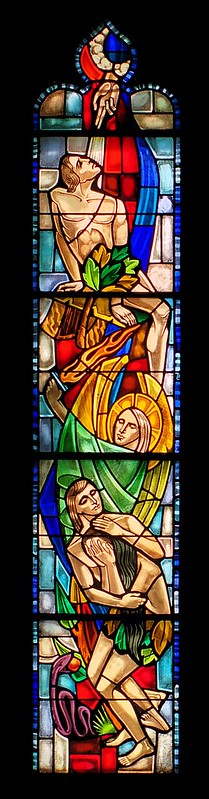 |
| The false religion of science feels greatly threatened by the Biblical account of the creation. |
Science is not a religion. Science is merely a systematized method of learning about the world around us. However, much of what is popularly believed to be science isn’t real science, but is actually a religion which uses the language of science and has rituals which make a pretense of scientists at work, but is not really scientific inquiry. You see this most often when true scientists are ridiculed and dismissed as “unorthodox” or “heretical” when they question popularly held beliefs despite the fact that the scientific method actually requires scientists to question and test theories and try to disprove them. You should note that when you are talking about “belief” you are talking “faith language” which signifies religion, not science.
The Scientific Method
True science is based solely on the Scientific Method, not on consensus, not on political ideology, not on popularity, and certainly not on wishful thinking. The scientific method has built into it a means of questioning and rethinking its findings when new evidence is found which contradicts what is believed to be a solid hypothesis. The Scientific Method says that the original hypothesis may have to be revised. This is why scientific findings are often a fluid, moving target. As we learn more about the world, we find that it isn’t exactly what we thought it was, but is considerably more complex. Here is one way the Scientific Method is described:
Question – How does the world work?
Research – Learn what information has been observed about the particular phenomenon which interests you.
Hypothesis – Make an educated guess concerning the issue at hand.
Experiment – Test your hypothesis to see if it accurately describes the phenomenon.
Analyze – Does the data you collected in your experiments support or contradict your hypothesis? You may find that your experimental results do not give enough information, and either need to revise your experimental procedure or revise your hypothesis.
Conclusion – Review the data and check to see if your hypothesis accurately described the phenomenon you observed. You may need to reformulate your hypothesis and experiment and analyze more to describe the world in the most accurate way.
Science is Based on Objective Observation
 |
| Movies are a kind of optical illusion where a series of still photos shown in rapid succession simulate motion. |
We all have seen optical illusions, which are images which fool the eye in one way or another. There are many kinds, and I am sure that a quick Internet search can find many optical illusions. These illusions work because through experience we have preconceived notions about what it is that we are seeing. This has to do with how we recognize what we see. Optical illusions play with how our eyes see, and how our mind recognizes what we are looking at. In other contexts we might call this prejudice. That is to say that our minds pre-judge what we are seeing so as to make recognition easier in most circumstances.
 |
| This is drawing has been around for many years. The duck is facing left, and the rabbit is facing right. |
The history of science is filled with stories of how scientists had observed a particular phenomenon repeatedly, and they either ignored it – because they didn’t understand it – or were unable to accurately describe it because their preconceived ideas got in the way. Only when someone was able to recognize the prejudice and view the phenomenon from a different perspective were the great scientific discoveries made. Those people who were able to do this are the ones we often describe as the great scientists and discoverers. They often didn’t really discover the phenomenon first, but they were the ones who were able to objectively describe what it was they were observing.
Science is Not the Source of All Knowledge.
Science can reveal some truth, as far as it goes, but it is not, and never will be, the source of all that is known. It is quite a myopic view that says that science is the source of all knowledge. Science does not tell us about the lives and accomplishments of people such as Alexander the Great, Plato, Aristotle, and Martin Luther, to name a few examples. History provides us with that information. Even the great scientific achievements of the twentieth century cannot wholly be explained by science alone. For example, science can tell us how to send a rocket with astronauts to the moon and bring them back safely, but it cannot tell us why we would want to do such a thing, or why we might prefer to refrain from attempting such a journey. Why did we send men to visit the moon? Was it curiosity? There was curiosity, but no, curiosity wasn’t enough. Nor was it enough to desire scientific knowledge about the moon or about other planets in our solar system. The scientific investigations that went with the moon landings were pretty much afterthoughts. The men who rode the rockets to the moon weren’t primarily scientists, they were military pilots.
 |
| Why did we send men to the moon? |
What is Religion?
Theology is the study of God. Religion is theology which is put into practice in a person’s life. This is true for all religions, both the true religion and the false religions. Whatever someone thinks of God affects his life in many ways. Religion is a way to serve God and it encourages the person to try to be like his God (or god). Even atheists practice religion. Every atheist or agnostic has a god (see below), though usually their god is themselves, and they try to live according to how they think a god ought to live. If atheists think a god should be benevolent, then they might have a civil righteousness and live as fairly decent people. If atheists think that god is cruel and capricious, and they have a propensity for psychopathy then they can become mass murderers. These are extremes, though most atheists and agnostics fall somewhere in the middle.
All people want to be like their God. If they view God as a vicious warrior then they will try to be like him and will live short, but cruel, violent lives. If they view God as merciful and forgiving, then they will be kind and easy to get along with. This is the essence of all religions. If your God is the true God, then your religion will be true. If your god is false, then your religion will be mostly false, though it may contain some fragments of truth mixed in with the false teachings. This doesn’t mean that anyone always practices true religion. All people are sinners and no one obeys God perfectly. Some people point to Christian sinfulness and say that we are all hypocrites, but that is not true. Christians are susceptible to hypocrisy just as much as pagans and atheists, but Christians aren’t hypocrites just because we are sinners. Christians ought not claim perfection for ourselves, though some false teachers do. Christ is perfect, and He lived perfectly for us, but He did that to redeem us from our sin. Christians repent of our sins and trust in Jesus to forgive us, but we should not claim perfection for ourselves. “If we claim to be without sin, we deceive ourselves and the truth is not in us. If we confess our sins, (Jesus Christ) is faithful and just and will forgive us our sins and purify us from all unrighteousness.” (1 John 1:8-9)
How to Distinguish Religion from Science
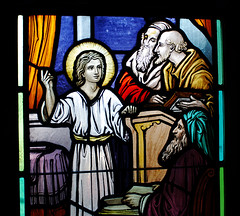 |
| In Luke 2, Jesus went to the teachers to learn, not to teach. His questions impressed them by showing His understanding. This depiction, and those like it, are wrong. |
Many people these days put their trust in science to answer all life’s problems and to provide comfort and rescue in times of trouble. When people do this they have made science their religion and their god. Understand me correctly that I am not saying that science is not a useful tool to learn about how the world works. However, those who make science their religion lose their objectivity and ascribe to science certain attributes which are only applicable to God, such as: infallibility, omniscience, holiness (in one way or another), and others. It is clear to see when people have turned science into a religion when they reject legitimate scientific inquiry into a hypothesis and say, “You can’t question that. It is proven science.” We also see people who have turned science into a religion when they state as fact unprovable assertions which are based on many assumptions, each of which can be questioned by science and other means of inquiry, such as, “The universe is (insert your favorite number here) billion years old,” and “science proves god doesn’t exist.”
Science and the Christian Worldview
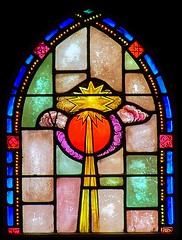 |
| In Genesis 1 God created light three days before creating the sun and moon. This shows God created the universe, not natural forces. |
We should also note that science, and the scientific method, assumes the Christian worldview (or one exactly like it). It was Christians who developed the scientific method as we know it because they trusted that God is a rational God, and that He created the world rationally, and so that it normally obeys orderly laws (which are often called the laws of nature). One doesn’t have to be a Christian to be a good scientist (though it always helps), but one must hold to a worldview which is compatible with the Christian worldview, which holds that God set the world to function according to certain laws.
You don’t get the scientific method from some theory like the latest revision of Darwinism, in which the primary agent of change is “accidents” which by their nature, are not repeatable, and rarely observable. If your worldview is based on non-repeatable “accidents” then it is, by definition, non-scientific. Remember that science is only able to describe those things which are testable according to the scientific method. Those things which are not testable are not provable by science, but fall under some other category. To be perfectly honest, this doesn’t mean that they didn’t happen, but you must use some proof other than science. It could be history, it could be a myth, it could be a lie, but if it can’t be tested and proven by the scientific method then you can’t call it “science” nor say it is verified by science.
Do You Believe in Science?
It is a very strange question when people ask if you believe in science. If you answer the question (either “yes” or “no”), then you are speaking the language of belief, not science. If science is something you believe in (or not) then that is your religion. On the other hand, if you define “science” by the scientific method, then science has little to do with belief. Proper science only speaks about physical laws which can be proven by experimentation, and it shouldn’t have anything to say about what cannot be proven experimentally.
Science cannot have all the answers to everything, It only provides insight into those things which can be shown experimentally. Not everything can be shown experimentally. For example, what is the meaning of life? Science has no answer, or if you think science does have an answer, you are missing out on a whole lot of data that science has no way of dealing with. As every scientist knows, if you don’t have all the data, or if you ignore important relevant information, then you will not find the correct answer to the question.
Scientific inquiry is important to our society, but there is more to life than science. However, some people have taken science too far, and have turned it into their religion and their god. People turn science into their religion when they put their trust in science above all things. What is worse is when people think that science says things that aren’t proven by science, and think that it has been proven. Such things include the existence and identity of God. Science also does not prove a materialistic worldview which believes that there is nothing in the universe besides physical things which are governed only by physical laws. Science is limited to observing physical things in the world, but that doesn’t mean that those are the only kinds of things that exist.
Charles Darwin: Scientist, or Religious Zealot?
One main reason for the shift from science to religion-masquerading-as-science was the popularizing of Charles Darwin in the 19th and 20th centuries. You don’t have to look too far to find people who consider themselves scientists who say that Darwin proved that God does not exist. This is completely false. Darwin neither proved the non-existence of God, nor did he prove that evolution accurately describes how life came to be as it is now. In fact, Darwin assumed the non-existence of God, and then he wrote a book which described this fictional world where God did not create everything.
Remember that in science, whatever is assumed is not proven. You cannot say, “Let’s assume there is no god. Therefore God does not exist.” That is neither logical, nor scientific. It’s just a joke. What if your initial assumption is wrong? Since, by definition, God is above the “natural laws” (because He created them in the first place), science cannot prove, nor disprove the existence of God. For that you need to examine other evidence. When people make statements like, “science proves there is no god” then they have departed from science, and have moved into the realm of theology (at best) or wild speculation (at worst).
Contrary to the wild pronouncements of activist atheist scientists, there is evidence to support the existence of God. Leaving aside (for now) the evidence in the natural world, the best evidence for the existence of God is the historical documentary evidence. Though I can hear now the objections forming in the minds of unbelievers, let’s be scientific for a moment and keep an open mind. Though one might be tempted to think that since most writings about the gods are false mythologies, that they are all false, but that does not follow logically. Just because one claim (or even many claims) about God is false, doesn’t mean that there doesn’t exist a true claim about God. In the same way one could look at science: just because all of the claims about the origins of man cannot be proven scientifically, it doesn’t mean that man does not exist.
Here I will add that it is a silly argument which I have heard that because man exists, therefore evolution is true. The mere existence of something does not prove a particular hypothesis about how it came to be. Evolution is one hypothesis, but there are others, and one or more of these may better explain the available evidence. Prove it if you can. This is yet another example of why people don’t “believe” in science. When scientists make such silly unscientific claims, they destroy their credibility. In doing this the “scientists” show themselves to be religious zealots who really don’t have a clue. Those who claim to be scientists must use good logic or they just show themselves to be untrustworthy. This also goes for religion. People must use good theology, or they also show themselves to be untrustworthy.
The Documentary Evidence for God
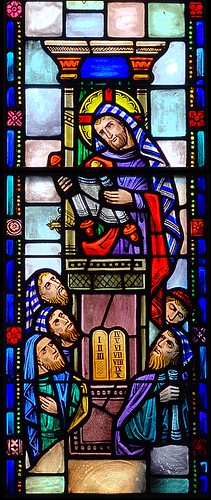 |
| Jesus made the teachers angry by showing them that He is the fulfillment of God's promises in the Bible. |
If you compare the Christian Scriptures to any other religion’s holy book, or any book of myths, and you will see that there is a clear difference. The Christian Scriptures are not mythical, but when they speak of historical events, it is detailed, and factual. The Christian Scriptures do not idealize the saints, but show them as flawed sinners. Archaeology also supports the Biblical history 100%. Though some archaeologists don’t want to believe the evidence confirms the truth of the Bible, a fair and complete reading of the archaeological evidence has always (yes, that is 100%) confirmed the Biblical account against the skeptics – and that is using the same evidence.
Evidence in Nature that God Exists
Many people would be surprised to learn that there is evidence in nature that strongly suggests (though does not prove) that God exists. The order in the world, and what we call the “scientific laws”, are reflections of God’s rationality and power. God, as He has revealed Himself in the Holy Scriptures, is a rational being. There would be no orderly universe if God hadn’t ordered it by His command. Science itself, is a reflection of the Christian worldview that God is a rational being who set in place natural laws to govern how things work in the world. Remember that those who created science as we know it in the Enlightenment period were Christians. They assumed that God is rational (as He describes Himself in the Holy Scriptures), and that He created an orderly universe which ran according to natural laws which could be discovered by investigation. You cannot get rational science from a Darwinistic or naturalistic worldview where things happen by accident. Where is the repeatability and orderliness of accidents? It is not there, and therefore it is not scientific.
The existence of life on earth provides many features which support God as creator of the world. The complexity of life is so great that it cannot have arisen by accident. Just look at the complexity of the DNA molecule which determines the physical structure and functioning of every living thing. The DNA molecule is a marvel of complexity which encodes many hundreds of thousands of base pairs which describe the unique person. The molecular structure of DNA forms a coded program which absolutely cannot have arisen by accident. The replication of the DNA in cell division also includes sophisticated error correcting mechanisms which are extraordinarily resistant to mutations. Though mutations can happen occasionally, they result in tragic consequences (i.e. death), not evolutionary consequences.
The Problem with the Religion of Science
One problem with turning science into a religion is that it becomes your god, and when you trust in science as you ought to trust in God, then when someone questions your scientific understanding (as is proper and necessary according to the Scientific Method) then those questions not only challenge your view of the world, but also your view of your god. We see this by the fanatically zealous way that so-called “scientists” reject any investigation into the validity of the prevailing theories of macro-evolution and the big-bang. Those who question the orthodoxy of the prevailing views on these topics are branded “heretics” (essentially) and their credibility is called into question, and all this without even examining the scientific value of their experiments. This kind of zealotry is usually reserved for religious beliefs, but because science has become a religion to many “scientists” we see it among those who otherwise would like to claim to be scientists.
To “believe” in science is to put your trust in the creation, rather than in the creator. However, you should remember why there is science in the first place. Science was developed in order to understand how the world works. We don’t fully understand how everything works. It is also true that we don’t (and can’t) fully understand God, either, but if we can admit that we don’t understand the world, then we ought to be able to (at least) leave room in our world for God, who created the world. If atheists were honest they would admit that their non-belief in God is just wishful thinking. Atheism is not natural among people. We all know that there is a god, even if some don’t know who the true God is.
The End of the World
Whether you believe in God, or believe in the currently favored natural explanation of how the universe came into being, you know that creation came into being in one day, and it will end in a similar way. The current explanation of the naturalistic creation is a “Big Bang” as a creative event. I can’t really take scientists seriously when they say things like that. Surely they can do better than that! Explosions are destructive events, not creative ones. Every explosion ever has proved this again and again. The fact that every computer model of the “Big Bang” has failed demonstrates that the universe was not created by an explosion. Do not take comfort in the idea that the computer model programmers have claimed to have gotten to within a fraction of a second of the beginning of the “Big Bang”. All that means is that their model has failed to show the creative nature of the explosive event, which is what we always observe. If the first few milliseconds of the “Big Bang” goes wrong, then everything afterwards goes wrong, too.
However, the atheist should not take comfort that he won’t be around to see the end because he will have long since passed into non-existence by that time. God has told us how things will end, and because Jesus Christ has destroyed the power of death for all people, and has promised to raise us all on the last day for judgment, we all would be wise to, at least, take some time to consider the claims of Christianity. Scripture describes the last day as a day of resurrection like this, “We will not all sleep, but we will all be changed in a flash, in the twinkling of an eye, at the last trumpet. For the trumpet will sound, the dead will be raised imperishable, and we will be changed. For the perishable must clothe itself with the imperishable, and the mortal with immortality.” (1 Corinthians 15:52-53) Then will proceed the judgment. It is not a judgment based on works. It is a judgment based on trust in Jesus as your savior from sin. Salvation is not based on merit, but salvation is the gift of God in Christ Jesus (see Ephesians 2:8-9). It couldn’t be any easier. Accept the gift and enjoy the blessings of salvation, or reject the gift and live in eternal regret and torment. (For more on this, see my article answering the presumptuous question: Why Does God Condemn Unbelievers to Hell?)
On the last day there is no option of non-existence. Christ has destroyed death for all, and gives salvation freely. All who reject Christ’s salvation choose to live in torment with the devil, whether they understand the choice or not. On the last day when we see Christ come in His full divine glory there will be no one who will fail to acknowledge Him as Lord and God. Those who belong to Christ through faith will rejoice that Christ has come to save us. Those who belong to themselves and to the devil through unbelief and rejection will mourn that they ought to have trusted in Jesus to save them, but did not. Either way, on the last day, there will be no denying that Jesus is God, and that His judgments are righteous and true, whether He judges to save you or to damn you.
A Sampling of Scripture Passages affirming God’s Creation of Everything
Genesis 1:1
“In the beginning, God created the heavens and the earth.”
Job 38:4-13
The Lord said, “Where were you when I laid the earth’s foundation? Tell me, if you understand. Who marked off its dimensions? Surely you know! Who stretched a measuring line across it? On what were its footings set, or who laid its cornerstone while the morning stars sang together and all the angels shouted for joy? Who shut up the sea behind doors when it burst forth from the womb, when I made the clouds its garment and wrapped it in thick darkness, when I fixed limits for it and set its doors and bars in place, when I said, ‘This far you may come and no farther; here is where your proud waves halt’? Have you ever given orders to the morning, or shown the dawn its place, that it might take the earth by the edges and shake the wicked out of it?”
Psalm 19:1
“The heavens declare the glory of God; the skies proclaim the work of his hands.”
Psalm 95:6-7a
“Oh come, let us worship and bow down; let us kneel before the Lord, our Maker! For he is our God, and we are the people of his pasture, and the sheep of his hand.”
Proverbs 14:31
“Whoever oppresses a poor man insults his Maker, but he who is generous to the needy honors him.”
Proverbs 17:5
“Whoever mocks the poor insults his Maker; he who is glad at calamity will not go unpunished.”
Proverbs 22:2
“The rich and the poor meet together; the Lord is the maker of them all.”
Isaiah 40:28
“Have you not known? Have you not heard? The Lord is the everlasting God, the Creator of the ends of the earth. He does not faint or grow weary; his understanding is unsearchable.”
Isaiah 51:12-15
The Lord said, “I, I am he who comforts you; who are you that you are afraid of man who dies, of the son of man who is made like grass, and have forgotten the Lord, your Maker, who stretched out the heavens and laid the foundations of the earth, and you fear continually all the day because of the wrath of the oppressor, when he sets himself to destroy? And where is the wrath of the oppressor? He who is bowed down shall speedily be released; he shall not die and go down to the pit, neither shall his bread be lacking. I am the Lord your God, who stirs up the sea so that its waves roar – the Lord of hosts is his name.”
Marching for Science as a Religious Rally
It is interesting that as I was working on writing this article, on April 22, 2017 there was a series of protest marches in several cities in the United States, and across the world that billed itself as a “March for Science”. In reality it was a religious (and political) rally for atheists, which was actually against real science. Marches are done to affect political change through educating voters about the value (or lack thereof) of their cause. This is not how science is done. Science is not done by political means, but by experimentation and showing the evidence. One of the stated reasons for the protest was to combat skepticism about “global warming”. This is anti-science also, because according to the scientific method, scientists are supposed to be skeptical about scientific hypotheses (like the claims of the global warming fear mongers), and must try to disprove the hypothesis in order to confirm or deny its validity.
One of the prominent speakers at the Washington D.C. march was the popular children’s TV celebrity, Bill Nye. Bill Nye is one of the most prominent high priests of the new atheist religion. Nye is infamous for saying that religion (specifically the Christian teaching of God’s account of the creation in Genesis) should not be taught to children because he thought it held children back in learning science. That was not a scientific statement either, but a religious statement. Nye is in favor of indoctrinating children in atheistic materialistic evolution (even though that is far short of being on solid ground scientifically), but he is completely against indoctrinating children in Christian doctrine which does not contradict true science. Nye has no problem with the teaching of science as long as it promotes atheistic evolution, but he doesn’t want the teaching of science if it shows that creation more likely happened as is described in the Book of Genesis which Moses wrote down 3500 years ago.
Can Monkeys produce Shakespeare?
 |
| The works of William Shakespeare are the product of a brilliant mind, not monkeys. |
Scientists and mathematicians are really not concerned about the writings of William Shakespeare. Shakespeare’s plays and sonnets are no threat to science. What they are really saying when they say that monkeys can produce Shakespeare is that the Bible is a book of fiction, or man-made myths (or worse), and that it cannot be trusted. Here again we can see that many atheist scientists are blinded by their religion. The historical truth of the Bible has been proven time after time by archaeology and other sources, even by skeptics who try and fail to prove the Bible wrong and become convinced that it is true. Since the Bible is historically true, then at least some thought should be given to the idea that it is also theologically and Spiritually true.
Since it is true that you cannot get Shakespeare from monkeys, then it is even more true that you cannot get the human genome from monkeys (or any other simple or complex organism). The ordering of the base pairs in the DNA molecule shows extreme complexity. Using only four “letters”, the DNA sequencing of even the simplest organism is at least as complex as a Shakespeare play, and more precise, because Shakespeare might have misspelled a word here and there and his meaning would still have come through, but a misspelling in the DNA sequence could mean the death of the organism. Wikipedia references a 1996 speech by Robert Wilensky, who stated, “We’ve heard that a million monkeys at a million keyboards could produce the complete works of Shakespeare; now, thanks to the Internet, we know that is not true.”
The idiocy of uneducated (or ill-educated) people on the internet may not actually disprove the religious zealots who fashion themselves as “scientists”, but it does confirm what the Holy Bible says about original sin. The Bible says that we are all alike conceived and born as sinners and are in need of forgiveness and redemption. However, God, has humbled Himself and entered our world as a man, Jesus Christ. He did this to redeem us from the guilt of our sin by fulfilling God’s Law on our behalf with His life, and also by offering His life in payment for ours. All who trust in Him to save them belong to Him and will receive His salvation. This is not a scientific fact, but a historical fact. God has had it written down and preserved for our benefit so that we may hear and believe. This doesn’t prevent Christians from learning and marveling at the mysteries of God’s creation, but it gives us great hope when this sinful world causes us sorrow, suffering and death. That is something that no amount of science can do.
The Temptation of the Religion of Science
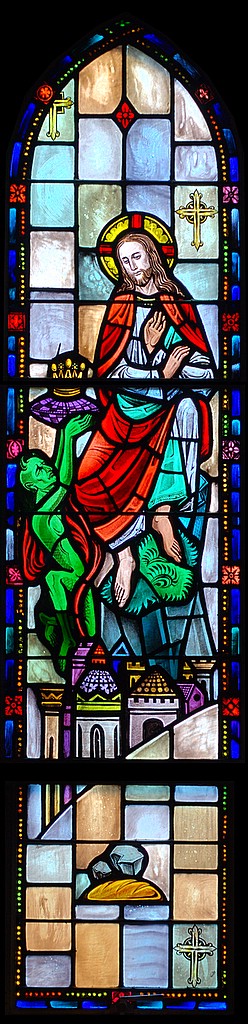 |
| The devil's temptations often seem very rational |
Gnosticism is a worship of knowledge, usually a secret kind of knowledge like what scientists claim for their discoveries. The religion of science is a modern form of Gnosticism. You will often hear scientists talking about discovering the “secrets of the universe.” When you view science like this, then it easily becomes your religion. If you think you know the “secrets of the universe” then you believe you know things that only God knows, and if only you and God have this knowledge, then you feel like you are equal to God and can judge God and you probably think that you are smarter than God. You can see how this can be very tempting. Who wouldn’t want to be smarter than God so that you can tell Him that He is wrong. This was, in essence, the temptation which brought down Adam and Eve when they were still holy and perfect, and so the sinful children of Adam and Eve have little chance to resist such a strong temptation.
“Humble yourselves, therefore, under the mighty hand of God so that at the proper time he may exalt you.” (1 Peter 5:6)
The Problem of Rationalism
Some people may think that if an argument is rational then it must be true. This is false. Every false teaching in history has begun by people trying to rationalize the Scriptures, but instead of finding the truth, they only come up with heresy. For example, even though the Triune nature of God can be found in both the Old Testament and the New Testament, it doesn’t make rational sense because it concerns God’s nature. Throughout history people have tried to rationalize the doctrine of the Triune nature of God and have come up with the false teachings of Arianism, docetism, modalism, and more.
 |
| Jesus gives His body and blood with the bread and wine of the Sacrament. This can only be true if Jesus is God. |
Another example is when people try to rationalize why some people are saved, but not others. The Scriptures teach that Jesus gave up His life to pay for the sins of all people and all who believe in Him will be saved, and all who reject Him will be condemned (John 3:16-17 and others). In this way Jesus is the cause of all who are saved, and the people themselves are the cause of all who are condemned. This doesn’t sit well with rationalists who don’t like the idea that there are two different causes for these opposite outcomes. Some rationalize it by saying that God is the singular cause, and He chooses some to be saved and some to be damned. This makes God to be evil because they are saying that He intends for some people to be condemned. This contradicts 1 Timothy 2:3-4 (and many others), “God our Savior … desires all people to be saved and to come to the knowledge of the truth.” Other people rationalize that God can’t be the cause of both salvation and damnation, but that we ourselves are the cause. They say we must make the choice, and our choice determines if we are saved or if we are damned. This is nowhere taught in Scripture, and it contradicts John 1:12-13, “Yet to all who received him, to those who believed in his name, he gave the right to become children of God – children born not of natural descent, nor of human decision or a husband’s will, but born of God.” Salvation is not a matter of our will, but of God’s will. Damnation, however, is a matter of our will, should we choose to reject God’s gift of forgiveness and salvation in Jesus. It is a paradox, and it can’t be resolved. Those who try may be rational, but they are false teachers.
There are many more examples. You could go through all heresies taught in history and find a rational basis. No heretic ever starts out trying to teach something false. He first tries to make sense of paradoxes, or mysteries beyond our comprehension, and in making the rational argument he must ignore and contradict some other clear teaching of Holy Scripture so that his rational argument teaches something false.
True science is relentlessly rational. That is its strength when it is used properly. One must keep in mind the limits of scientific inquiry before venturing into speculative theory and other areas where science cannot find answers or has nothing to say. Theoretical science is not – strictly speaking – science. Theories are only one part of the scientific method, and theories (or hypotheses) come early in the search for truth. Hypotheses are often proven wrong by experimentation. It is a great temptation to think that science or knowledge or rationalism will answer all our questions and solve all our problems. However science cannot solve the problem of sin and death. Only Jesus can rescue us from sin and death.
The Holy Scriptures were not written as a scientific textbook, but were written to bring us salvation through faith in Jesus Christ. The Holy Bible does not contradict true science, but rather encourages us to learn about the world that God created for us. We can never have all our questions answered because we are limited, and we can’t know everything. God does know everything, and he has given us the Scriptures so that we would put our trust in Jesus for our forgiveness and salvation. Science is only one of many gifts that God has given to us to make our lives better in this world, even though some use God’s gifts for evil. Don’t be led astray by those who make science into some godless religion. That is not what science is for. Don’t be led astray by those who say that the Bible isn’t true because it is not scientific. That is not what the Bible is for. The Holy Bible is to tell you what God, in Jesus Christ, has done to save you from your sins.