Showing posts with label bless. Show all posts

Sunday, December 25, 2022

The Holy Family

by Pastor Paul Wolff


The Holy Family
Window from Epiphany Lutheran Church,
Detroit, Michigan
(Now closed)

This past year (2022) my wife and I have been blessed to see our extended family grow. On the day of Epiphany we rejoiced at the birth of our fifth granddaughter. Then, not quite eleven months later, we rejoiced again at the birth of her niece, our first great-granddaughter. I don’t know what the deal is with all the girls. Statistically, you would expect out of six children born to the younger generations three would be girls and three would be boys. Children, aren’t born by statistics, however, and our grandchildren are all beautiful women and girls, and we thank God for all of them.

Children are truly a blessing from God, despite what the world may think of them. King Solomon wrote, “Behold, children are a heritage from the Lord, the fruit of the womb a reward. Like arrows in the hand of a warrior are the children of one’s youth. Blessed is the man who fills his quiver with them!” (Psalm 127:3-5) This blessing goes all the way back to the creation of the world where God created mankind as a husband and his wife and blessed them, saying “Be fruitful and multiply and fill the earth and subdue it, and have dominion over the fish of the sea and over the birds of the heavens and over every living thing that moves on the earth.” (Genesis 1:28) This blessing was given before the fall into sin, but God blessed Adam and Eve with children even after they rebelled against Him, but He also promised to send a Savior to rescue them all from their sin. God also repeated His blessing to Noah and his sons after God rescued them from the great flood, saying“Be fruitful and multiply and fill the earth.” (Gen 9:1) Even though every person ever born on earth (except Jesus) has been born a sinner, God still blesses families with children, and has provided salvation for all of us through Jesus. This is the reason why we celebrate with joy the birth of Jesus, and why it is also important to remember the Holy Family at Christmas (and at other times when we celebrate God’s gifts of new members to our family).


The Holy Family
at the Nativity of Christ
This is not the real Holy Family, but a lifelike representation
(compared to the other images in this article).
It is significant that when God became incarnate He came into a young family. In American culture, we would say today that Mary and Joseph were engaged to be married, because the marriage had not been consummated. In Jewish culture of that time, respectable people (like Joseph and Mary) would be legally married for a year – while living apart – before they consummated the marriage. You should note, too, that this practice was not only for prominent wealthy people, but also for laborers, like carpenters. It didn’t matter if Joseph was a skilled master carpenter or an unskilled laborer. People of all social classes would demonstrate their integrity by waiting a year before consummating the marriage, thus showing that they had not engaged in physical intimacy with each other. This not only gave them time to prove they were chaste and hadn’t been unfaithful, but it also gave them time to solidify their lifelong commitment to one another, and to the new family that they were creating.

God could have chosen an unmarried virgin to bear God’s Son, but that is not how God works. God, in His wisdom, created marriage and family for a purpose and He blesses families. In an intact family, the children know the love of both their father and their mother (see the Fourth Commandment – Exodus 20:12). This is God’s good plan, and though in this sinful world, this is not always possible, it is what we should strive for at all times. Besides, as God planned it, we have the “holy family” to look up to and try to make our own families holy also. We do this through repentance and forgiveness of one another when we sin against one another as we inevitably will. If God had become incarnate through an unmarried woman, then Christians would idealize unmarried mothers and that would necessarily result in all kinds of chaos, like we see in pagan America today: children growing up in broken families feeling unloved and disobeying authorities and getting involved in drugs and crime. Our prisons are overwhelmingly populated with children of broken families.
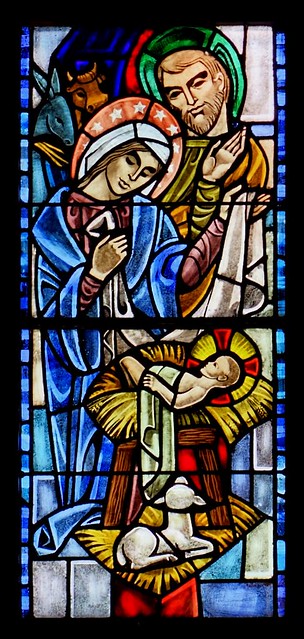
The Holy Family
Window from Holy Cross Lutheran Church,
Detroit, Michigan
(Now closed)

As it is, Joseph and Mary belong together, and we ought to try to emulate their purity and faithfulness. Though, I should say here that the “pious” idea of Mary’s lifelong virginity is pure wickedness. That would make her a lousy wife to withhold herself from her husband (see 1 Corinthians 7:1-5). Mary is perpetually a virgin in our memory because we perpetually remember her as “the blessed virgin”, or the “virgin mother”. We do this because Mary was still a virgin until after Jesus was born (see Matthew 1:18-25). This is important because it testifies to the fact that Jesus is the Son of God, not the physical son of Joseph or any other sinful man, though Jesus lived as the son of Joseph, and was named as such (see Luke 2:48; Luke 3:23; Luke 4:22; Matthew 13:55; John 1:45; and John 6:42). There is no confusing the Blessed Virgin Mary with anyone else because never before and never again will a virgin conceive and bear a child. We also see in Matthew 13:55 and Mark 6:3 that the brothers of Jesus are named and the Gospel writers make note that they have sisters, also. The most plain (and best) interpretation of this is that these are the natural children of Joseph and Mary. There is no reason to doubt that – either historically, or exegetically, or theologically.

The “holy family” is considered holy because Jesus is holy. Joseph and Mary were sinners in need of Jesus to save them from their sins. In the Magnificat (Luke 1:46-55) Mary calls God, “my savior” (v. 47). Yet, despite the fact that Joseph and Mary were just like everyone else, they were also faithful, pious believers. As a young married couple, they were chaste and pure. When Joseph learned Mary was pregnant, he knew he was not the father, and though he was not (at first) willing to believe what Mary must have told him about what the angel said, he could have intended to have her stoned for adultery, but instead he planned on divorcing her quietly and not subjecting her to public disgrace. Then, when God told Joseph in a dream that all Mary had told him was true (see Matthew 1:20), he believed and kept the family intact. Joseph later protected Mary and Jesus by taking them to Egypt after Herod sought to kill the child, who was the true King of Judah (see INRI).

The Holy Family
Window from Emmanuel Lutheran Church,
Dearborn, Michigan

The world despises children because it takes sacrificial love to properly raise a child. Selfish pagans idolize themselves and do not care to expend the love and time and money it takes to provide for a child’s needs of body, soul, and mind. Parents must sacrifice to provide for their children’s needs, but that is what people were made for. It is very rewarding to raise a child and give him or her the necessary skills and resources necessary to become a respectable, productive member of society. It is even more rewarding for Christian parents to raise a child who loves God and his neighbors, and trusts in Jesus to save him from his sins. Parents who have done a good job raising children can be justifiably proud that their children are admired and respected by their neighbors and friends, and are valued members of society who care for those whom they deal with every day. This is something that selfish unbelievers who despise and murder their children (see my article on Molechianism) will never fully know because they idolize themselves, and they are unfulfilled because sooner or later their false gods will fail them.

No family is perfect, however, because all members of families are sinners. Even the holy family must have had its struggles and difficulties. The presence of Jesus did not change the sinful nature of Joseph and Mary, nor of His brothers and sisters. The story of the boy Jesus in the temple at age 12 (Luke 2:40-51) shows us that as the years went by, Joseph and Mary seem to have taken for granted that Jesus was the Son of God, and just thought of Him as a normal boy – which He was. There seems nothing out of the ordinary in the way that they deal with Him, as their son. They do show a high level of trust in Him, as they weren’t particularly worried that He wasn’t with them for a time. They assumed that Jesus was with others in their group (v. 44) as they traveled back up north, and they trusted Him not to be disobedient. Jesus always obeyed them perfectly, as an obedient son, but somehow not in a way that drew attention to Himself – so they trusted Him. Though, Mark 3:20-34 describes a situation where Christ’s family (specifically, His mother and brothers) thought Jesus was out of His mind, but Jesus kept teaching what He had been teaching because He was doing what He was supposed to do, and few others understood what it was all about. They thought Jesus suicidal for calling the leaders to repentance, and not heeding the threats against His life. Jesus was not suicidal, and at various times had to walk away from imminent threats to His life before His work was finished (See John 6:15 and Luke 4:24-30), but neither did He try to save Himself when the time came for Him to give His life to pay the price for the sins of the world (see Matthew 27:12-14). Some of the people who heard Christ’s teaching understood after He died and rose to life again, but others never did.

Glory to God in the Highest
Jesus is born in Bethlehem
(I forget where this window is from.
This is a scan of an old film photograph.)

It seems strange to the world that God would become a man simply for the purpose of suffering and dying a shameful death on a cross. It is no wonder that Christ’s family thought Him out of his mind. That kind of love doesn’t make sense to our selfish, sinful flesh, but God’s love is perfect, and we see perfect love in the life and death and resurrection of Jesus. That is why we celebrate Christmas, and why we celebrate more on Good Friday and on Easter Sunday. God is the only one who can save us from the guilt of our sin, and rescue us from sin’s consequences. So God became a man in Jesus to redeem us from sin and death. This is perfect love in action – that God would live and die to save His disobedient people, so that He could make us holy to live with Him forever.


This Christmas may Christ bless your family as you contemplate the Holy Family. May you love one another as Christ has loved you. May you forgive the sins that your family members commit against you, as Christ has forgiven all your sins. May father and mother be strengthened in love and commitment to one another, and may children give thanks to God continually for the blessings of their family.


Psalm 144:9-15 (NIV)

I will sing a new song to you, O God;
on the ten-stringed lyre I will make music to you,
to the One who gives victory to kings,
who delivers his servant David from the deadly sword.
Deliver me and rescue me from the hands of foreigners
whose mouths are full of lies, whose right hands are deceitful.
Then our sons in their youth will be like well-nurtured plants,
and our daughters will be like pillars carved to adorn a palace.
Our barns will be filled with every kind of provision.
Our sheep will increase by thousands,
by tens of thousands in our fields;
our oxen will draw heavy loads.
There will be no breaching of walls,
no going into captivity,
no cry of distress in our streets.
Blessed are the people of whom this is true;
blessed are the people whose God is the Lord.


Here are my other Christmas-themed articles from this blog:

What was Jesus like as a Boy?

Come, Lord Jesus! 

God’s Justice and Mercy at Christmas 

Justice at Christmas 

Christmas Peace is Forever 

Is Christmas Offensive? 

Christ is for You 

God is With Us 

Does Jesus Sing? 

The Incarnation of God

Magi

Shepherd Visitors

Don’t Make Me Come Down There!


Thursday, August 25, 2022

You Shall Not Murder

(Part One in a Series)

by Pastor Paul Wolff


God first wrote the commandments
in our hearts.
But after the fall into sin
God wrote them on stone tablets
which He gave to Moses and the Israelites
at Mount Sinai.
The sin of murder is considered to be the worst sin that a person can commit against another. Though you have to wonder, since murder is so bad, then why is it so popular? And why is murder seemingly gaining in popularity (at least in America and several other places around the world)? As I was researching this topic I saw a news story which said that murders in the United States were up 30% in 2020 over the previous year. Though 2020 was a chaotic year with all kinds of government leaders at many levels all around the world acting like tyrannical dictators. That kind of high profile lawlessness always leads to lawlessness at every level, and murder is the epitome of lawlessness.

All sin is equally evil in God’s eyes. God is holy and sinless, and He first made people holy and sinless as He is. All mankind was condemned to live in sin because of what was essentially Eve’s sin of thievery which was combined with coveting and idolatry (the underlying sin which leads to all other sins). However, that theft was full rebellion and rejection of God, and the equivalent of murder since it has so far led to the death of everyone born before 1903 (and hundreds of millions of people since then), though one man has risen from the dead and still lives.

God gave us the Fifth Commandment (as Lutherans and most other Christians count the Commandments), “You shall not murder,” because God is the “Living God.” God is called the “Living God” not just because He is alive, but because He is the source of all life, and the only one who can give life to the dead. God gave us the Fifth Commandment because He doesn’t want anyone killing the people whom He loves (including you, your neighbors, and your enemies). So we see that this commandment is good, as all of God’s commandments are good. You don’t want your neighbor murdering you, and neither does God – so God commanded “You shall not murder.”

The sin of thievery seems to be of lesser degree
than the irreversable sin of murder.
But both sins need Jesus to forgive them,
so we may be saved.
Although all sin is equally condemned in God’s eyes, there is something unique about the sin of murder. By contrast, we see in Luke 19 the tax collector, Zacchaeus, repented of his thievery (forbidden by the Seventh Commandment: “You shall not steal.”) and promised, Lord! Here and now I give half of my possessions to the poor, and if I have cheated anybody out of anything, I will pay back four times the amount.” (Luke 19:8) Zacchaeus was certainly a wicked sinner (though as I have written elsewhere simply being a tax collector was not one of his sins – see also Luke 3:12-13), but since his wickedness primarily consisted of thievery, he was able to pay back what he had stolen, with a little extra as penance to show the sincerity of his repentance, and compensate those he sinned against for their inconvenience. Such “penance” does not even begin to undo nor remove the guilt of the sin, but it shows the sincerity of the repentance, and it can help assuage the anger of the person you sinned against so that they may be less likely to murder you for your thievery. However, when one’s sin involves murder, then what is stolen cannot be returned for love, nor money. Once you take a person’s life, it is gone permanently, and can never be given back. This is somewhat unique in the second table of the Ten Commandments, and makes murder seem worse than other sins committed against other people.

You will sometimes hear people say, “… at least I am not a murderer.” You know that someone is trying too hard to justify their pet sins when they say this. Murder is a pretty low standard for anyone to measure up against. That person is actually saying, “I may be a dreadfully wicked person, but at least I am not the worst person (for now).” Of course, once you get to this point, the sin of murder (in one form or another) is likely to follow soon thereafter.

Despite the horrific nature of murder, there is no lack of examples of murder in the Bible. This shows the corrupting nature of sin. The first person born on the earth (after God created Adam and Eve) ended up murdering his younger brother. When I have taught the Ten Commandments I have noticed that sins against all the Commandments in the Second Table (and likely all of the Commandments in the First Table, also) can lead to murder. From this I have concluded that there are many different causes of the sin of murder, such as dishonoring parents and authorities, adultery, theft, lying, and covetousness. However, as I have studied the Holy Scripture further, I believe there is a single underlying foundational cause of murder which leads to all the other superficial immediate causes of this terrible sin.

Any sin against the Second Table of the Commandments can lead to murder because these sins are committed against our neighbor. Taken to the extreme, every sin can lead to murder because murder is the ultimate expression of the sins against your neighbor, including dishonoring parents and authorities, adultery, theft, lying, and covetousness. There are also the so-called “seven deadly sins” which are pride, greed, wrath, envy, lust, gluttony, and sloth. Although not all of these are always sinful (there can be righteous anger, and possibly pride – though righteous pride is much more rare than you might like to believe), these all could be considered deadly because they can lead someone to murder, and they lead people to lose faith in Jesus or lead us to reject Christ’s forgiveness and salvation.


In the Parable of the Good Samaritan
The Priest and the Levite did not hurt the injured man,
but neither did they help him.
As we consider the Fifth Commandment we should recall Martin Luther’s teaching on the meaning of the Fifth Commandment. “We should fear and love God so that we do not hurt or harm our neighbor in his body, but help and support him in every physical need.” Note that there are two parts: a negative and a positive part. We should first not hurt nor harm our neighbor in his body. This is the negative part. This is the wrong thing that we should not do. You should also note that what is forbidden is not only the extreme of murder, but God also forbids you from hurting or harming your neighbor in any way! However, as with all the commandments, there is also a positive good that we should do to keep this commandment. We should help and support our neighbor in every bodily need. It is not enough to avoid killing our neighbor with our own actions, but we must also help and protect our neighbor’s body and life. An example of this in Scripture is Christ’s Parable of the Good Samaritan (Luke 10:25-37). The priest and the Levite did not lay a finger on the man laying on the road to Jericho to hurt him, but neither did they lift a finger to help him after the robbers left him for dead. So, in God’s eyes, they were just as guilty of murder as the robbers who beat the man and took his possessions. In another article I will show how Jesus kept the Fifth Commandment by not only abstaining from murder, but by helping and healing those who were sick, injured, and dead.

Murder may have many immediate causes such as coveting, lust, greed, envy, hatred, and others. Yet underlying all of these immediate causes there is a fundamental sin which leads all these different causes to end up with the same result of murder. That fundamental murderous sin is an idolatrous selfishness which leads people to take into their own hands the power over life and death, which rightly belongs only to God. When someone begins to justify his pet sins in his own mind he is likely to forget God’s commandments and it is sometimes a short step to think that one’s own sinful desires are good and right. Once that happens, even the lives of others become secondary to what the sinful person desires. This is what we call “hatred”. I have shown elsewhere that no racist person begins by hating others. It can begin with something as seemingly innocent (though still wickedly sinful) as wanting what is best for a group that I identify with – over and against one or more groups that I don’t identify with. Sinful desires can grow into the same murderous hatred even though they have one of several different starting points. This is why we must repent of our sins early and often. Martin Luther suggests that we use our Baptism correctly if we remember our sinfulness daily and “drown” the old sinful nature through contrition (sorrow over sin) and repentance, trusting in Jesus to forgive our sins and give us what we need, even if it is not what we necessarily desire. If we delay repenting then those sinful desires grow into actual sins of word and deed, and can lead to murder long before we realize it.

In the days of Noah, God saw that
“the wickedness of man was great in the earth,
and that every intention of the thoughts of his heart
was only evil continually.” (Genesis 6:5)

Because God created us He knows full well how our hearts are set on evil, including murder. God didn’t create people to murder, but to appreciate His gift of life and also for husband and wife to create new life through their expression of love for one another. Though sin has corrupted all of this, life is still a gift from God for which we can rejoice and be thankful. Also, in history, God has used our murderous desires to accomplish our salvation. Because sinful people desire to be gods ourselves, we believe we have to get rid of the real God because to our eyes He “gets in the way”. In our sinful delusions, we think we are holy, but the ugly truth is immediately apparent when we are in the presence of true holiness. What God did was to become incarnate as a man, Jesus of Nazareth, and when the time was right He let sinful men do to Him what sinful men always wanted to do to God, which is: to murder Him. This accomplished our salvation because Jesus is truly an innocent man, but He allowed Himself to be killed as a substitute for us. Jesus took the guilt of our sin upon himself, and suffered death innocently in our place so that God’s wrath over our sin could be poured out upon Jesus, and we could be forgiven and (eventually) remade as the holy, eternal, people whom God intended for us to be in the first place. The poetic irony of using our murderous tendencies to accomplish our forgiveness and salvation and eternal life is amazing, and the love of God, which caused Him to live and die for us sinners, is so amazing and wonderful that we, who appreciate what He has done to save us, will literally love Him forever in return.

Despite the terrible finality of murder, God still forgives repentant murderers. Murder is a sin in God’s eyes, like any other sin. The number of murderers in hell is not an indication that God does not forgive murderers, but that the murderers feel so guilty that they despair and think their sin cannot be forgiven, and so they do not repent and seek God’s mercy and forgiveness. In this life we think we have to pay for our own mistakes, but the sin of murder is too big. This leads to despair, and an unrepentant attitude which leads to damnation. Murder is not unforgivable, but the guilty murderer must repent and trust in Jesus to forgive him or her.

Jesus is the Good Samaritan
who saved us sinners from death
at the great cost of His own suffering
and death on the cross.
Jesus taught in the Sermon on the Mount, “
You have heard that it was said to the people long ago, ‘Do not murder, and anyone who murders will be subject to judgment.’ But I tell you that anyone who is angry with his brother will be subject to judgment. Again, anyone who says to his brother, ‘Raca,’ (a curse) is answerable to the Sanhedrin. But anyone who says, ‘You fool!’ will be in danger of the fire of hell.” (Matthew 5:21-22) This shows us that the sin of murder is more than just the extreme action of taking someone’s life. God gave us all life, and cares for our well being in every aspect of our life. This is why Martin Luther explained the Fifth Commandment as he did (see above).

Jesus did not murder, in any way, but helped His neighbors by healing them from all kinds of sickness, disease, injury, and even death. Then Jesus allowed wicked men to conspire against Him to have Him murdered. Jesus allowed them to murder Him as a sacrificial lamb so that He could take our place and suffer the wrath of God the Father for the sins of the world. Jesus did this so that you could be redeemed and rescued from sin and death.

Murder is a dreadful sin, and a terrible evil, but it is not unforgivable. Jesus died to pay the price to redeem murderers, as well as all sinners. If you are guilty of murder, or hatred, or neglect, or any other sin which breaks God’s commandment against murder, then repent and trust in Jesus to forgive these, and all your sins. It is a great comfort to know that the almighty and Holy God forgives even the sins of the worst sinners, that God may be praised and glorified forever for His great love and mercy.

Other Articles in this series:
The True God Cannot Murder 

The Opposite of Murder

 
Related Articles:
Why Does God Condemn Unbelievers to Hell?
A Biblical Argument for Self Defense
Anger
Why Christians Condemn Abortion but Support the Death Penalty
The Good Samaritan
Is it Easier to Heal, or to Forgive?
Christ Has Done All Things Well
The Promise of Christ in Water And Light
Modern Molechianism
“Let His Blood be on Us and on Our Children”
The Passion of Christ
The Slaughter of the Innocents
Friends and Murderers
The Promise of the Rainbow
The True Story of a Terrorist Turned Christian
The Morality of War
Rejecting the Survival Instinct
The Leading Cause of Death in America