Showing posts with label inherit. Show all posts

Friday, February 17, 2023

Blessed are the Meek, for They Shall Inherit the Earth

(Part 3 of a series of 9 articles on the Beatitudes)

by Pastor Paul Wolff

Blessed are the meek
for they shall inherit the earth.
Matthew 5:5
Photo from a mosaic in the
Saint Louis Cathedral, St. Louis Missouri
In the third Beatitude, Jesus says, “Blessed are the meek, for they will inherit the earth.” (Matthew 5:5) Meekness is not something Christians would seek for themselves unless it was blessed by Christ. To be meek is to be humble and submissive to authorities, and not asserting one’s rights over others, but viewing others as greater or more important than yourself. Meek people are helpful and kind and are just the sort of people you are grateful to have helping you when you are in trouble or need and have nowhere else to turn. A meek person is a good and faithful friend, and just the sort of person who would “give you the shirt off of his back” if you are in need.

The world says, “might makes right” and “power rules” and other such things. The world despises the meek as weak and powerless people who are to be taken advantage of, and enslaved (if possible). Marxism, especially, is all about the exercise of power, and though we all hoped that Marxism was on its way to oblivion – where it belongs – after the fall of the Berlin Wall in 1987 and the subsequent collapse of the Soviet Union, but it seems to be gaining in popularity by ignorant people who don’t mind becoming tyrants who are cursed by all good, peace-loving people whom they oppress.

Marxism would be a very funny joke if people didn’t take it seriously and murder people on an industrial scale. The idea is that there are two types of people: oppressors and oppressed. You could picture two people where one imagines that he has been wronged (oppressed) by the other in some small way and slaps the other. Now the tables are turned, and the other person is oppressed and he slaps back. Since these are both committed Marxists this continues until one gets tired of being slapped and hits back harder. This necessarily escalates until one murders the other. This is the necessary result of Marxist ideology and it cannot be any other way, unless one or both gives up on this demonic way of thinking.

Meek people are not necessarily oppressed, and need not view themselves as such (even when they are). Meekness is about how individuals act toward others in love. Jesus said later in the Sermon on the Mount that Christians ought to “turn the other cheek” (Matthew 5:39) when someone strikes them in the face, rather than escalating the fight to murderous levels. This is how Christians are meek in love – not asserting their “rights” but forgiving their neighbor in love, and enduring all kinds of indignities for the sake of Christ. This is not cowardice at all (though the world may mistake it for cowardice), but meekness comes from the brave trust in the forgiveness and justice of God, and showing their neighbors the love of Christ in their lives.

Though Christian meekness is a virtue, we should understand that we cannot win salvation by being meek. There is nothing that anyone can do to save themselves. James (2:10) says, For whoever keeps the whole law and yet stumbles at just one point is guilty of breaking all of it. We are all conceived and born in sin, and have inherited the corruption and guilt of sin, so none of us can save ourselves. Yet since Christ Jesus has redeemed us and gives us salvation and eternal life as a gift, then we don’t need to “assert our rights” and “take justice into our own hands” but we can leave vengeance to the righteous judgment of God. Scripture says, Do not take revenge, my friends, but leave room for God’s wrath, for it is written: ‘It is mine to avenge; I will repay,’ says the Lord. (Romans 12:19 – from Proverbs 20:22 and Deuteronomy 32:35)

The inheritance of the meek
is not this corrupted, sinful world,
but the new earth God prepares for His people.
(See Revelation 21)
The blessing that Christ promises to give the meek is that “they shall inherit the earth”. Obviously this is not something that we should expect to happen in this sinful world. Nor should we seek to take the earth by force. Those who seek to gain control of the earth by force are rightly punished by the authorities which God has established on earth. This “inheritance” is a passive thing, which is a gift from God. Psalm 24:1 says, “The earth is the Lord’s and everything in it, the world and all who live in it.” We can only inherit the earth if God considers us His children and gives it to us as an inheritance. We are God’s children through faith in Jesus Christ, and the new birth which God the Holy Spirit, gives to us in holy Baptism. The “born again” miracle which the Holy Spirit works through Baptism (John 3:5-6) is to adopt us as His children and give us each a new life which is forever. In the same way, the “earth” that we inherit is not this sinful world which is condemned to destruction (Revelation 21:1), but it is the new earth which God is preparing as a paradise for our eternal life with Him.

Jesus was meek
to fulfill God's plan of salvation
to redeem us from our sins.
Jesus was meek in many ways from His conception to His death. Some misguided rationalist heretics have sayings to the effect of “you can’t put god in a box”, or “the finite cannot contain the infinite”. Yet, in the incarnation of the Son of God, that is exactly what the Omnipresent, Almighty God did. At the conception of Jesus, the Second Person of the Trinity was present bodily in a newly conceived, one-celled person who grew up to be Jesus, the Christ, the son of Mary. Jesus is not part-god and part-man. Jesus is fully God and fully man. This is a paradox, to be sure, but it is something that only God can do. Though even in mathematics there is the concept of a structure with infinite surface area contained within a limited, finite volume, so even in the physical (or mathematical?) world the heretical sayings are not true. Even though Jesus, as God, is eternal, omnipotent, omnipresent, omniscient, and more, He lived life as an ordinary man for about thirty years (Luke 3:23) before He began His ministry, and then He didn’t use His divine powers completely, but only for specific purposes.

Though Jesus is the creator (with the Father and the Holy Spirit) of all that exists, He did not come in power and glory, but was born quietly in Bethlehem. Because the census required people to register at their ancestral home, Bethlehem was crowded and no one made room for the birth of the Son of God, He spent His first night after His birth sleeping in a manger. Though after the local shepherds heard what the angels said about Him, surely more comfortable accommodations were found for the holy family after that. When the magi from the East came to worship the King of Judah, they went to Jerusalem first because they expected the newborn king to be in the royal palace in the capital city, yet the Holy Family was still in Bethlehem. This is one way which shows the meekness of Jesus. This was according to God’s plan. God became incarnate in Jesus in order to serve us sinners, not to rule in power. God has all power, but He came meekly to provide forgiveness and salvation for us all.

“He was oppressed, and he was afflicted,
yet he opened not his mouth;
like a lamb that is led to the slaughter,
and like a sheep that before its shearers is silent,
so he opened not his mouth.”
(Isaiah 53:7)

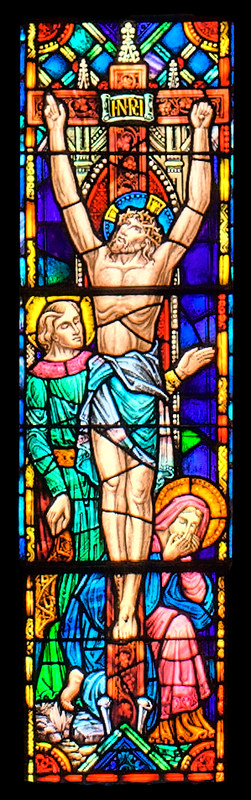
The ultimate expression of the meekness of Jesus was His passion. When His work was done, He allowed His enemies to arrest Him, put Him on trial prejudicially, and crucify Him. Jesus was meek as he was led to his crucifixion. This fulfilled the prophesy from Isaiah, “He was oppressed, and he was afflicted, yet he opened not his mouth; like a lamb that is led to the slaughter, and like a sheep that before its shearers is silent, so he opened not his mouth.” (Isaiah 53:7) Sheep don’t mind going to the shearers, but Jesus knew He was not just going to get a haircut, but would suffer and die a horrible death. Even his judge, Pontius Pilate, was surprised that Jesus didn’t defend himself from outrageous, unsubstantiated accusations. He was mocked, beaten, and nailed to a cross. No false god in the world would be caught dead on a cross, but the true God was there to pay the price for the sins of the world. The result of Christ’s sacrifice is the full forgiveness of sins, and salvation for all who put their trust in Him. Because Jesus faithfully fulfilled God’s plan for salvation the result for Him is described by Saint Paul in this way: “Therefore God exalted him to the highest place and gave him the name that is above every name, that at the name of Jesus every knee should bow, in heaven and on earth and under the earth, and every tongue confess that Jesus Christ is Lord, to the glory of God the Father.” (Philippians 2:9-11) Now, that Jesus has paid for our sins and won our salvation, He is glorified, and uses His divine power fully always. Perhaps the only meekness He displays now is that He remains hidden, and He allows sin on the earth (with limits). When Jesus returns on the Last Day we will see Him in all His glory and power. Then He will judge the world and fulfill His promise to give His beloved children the inheritance of the new earth.


Other articles in this series:

Blessed are the Poor in Spirit

Blessed are Those who Mourn, For They Will be Comforted 

Blessed are Those Who Hunger and Thirst for Righteousness, for They Shall be Satisfied

Blessed are the Merciful, for They Shall Receive Mercy 

Blessed are the Pure in Heart, for They Shall See God 

Blessed are the Peacemakers, for They Shall be Called Sons of God 

Coming soon:

Blessed are those who are persecuted for righteousness’ sake, for theirs is the kingdom of heaven.


Monday, September 4, 2017

The Good Samaritan

by Pastor Paul Wolff

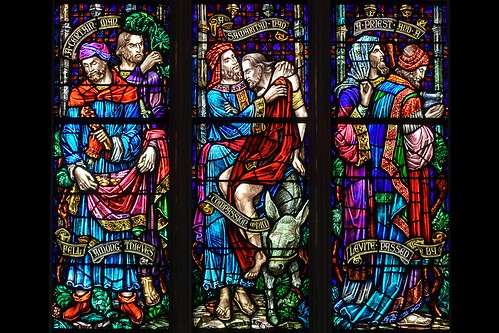
A certain man fell among thieves
A Samaritan had compassion on him
A Priest and a Levite passed by

 
Luke 10:33-35

Jesus said, “A Samaritan, as he journeyed, came to where (the injured man) was, and when he saw him, he had compassion. He went to him and bound up his wounds, pouring on oil and wine. Then he set him on his own animal and brought him to an inn and took care of him. And the next day he took out two denarii and gave them to the innkeeper, saying, ‘Take care of him, and whatever more you spend, I will repay you when I come back.’”


People are afraid of the Law, and think the Law is evil because the Law condemns us as sinners. However, the Law of God is not the problem. God’s Law is good, as God is good, and the Law shows us what is good for us to do to love God and love our neighbor. Sinners think the Law’s condemnation of sinners is bad because we don’t want to be condemned. Sin blinds us to the reality of just how wicked we really are, and how much we really deserve to be condemned.

Remember what happened in the Garden of Eden with Adam and Eve. God made the whole world good and gave it to Adam and Eve for their benefit and enjoyment. The only thing forbidden to them was the fruit of one tree – one tree in the whole world. In effect, God was saying, “This tree belongs to me. Don’t eat its fruit. If you eat the fruit of this tree you will die. But look, here is another tree. This is the tree of Life. You are free to eat from this tree and anything else in the world that you wish to eat. I am your Father and I love you, and I want you to live and enjoy all the good things that I can give to you forever.” God gives us good things, and forbids us from doing things that will hurt us.

The problem isn’t God’s Law. The problem is that people rebelled against God’s good Law and chose sin and death instead of righteousness and life. Sinners despise what is good, and we twist and distort God’s Word to make the Law seem to say what we want it to say, instead of receiving it as God has given it to us for our good.

It is no coincidence that the man who tested Jesus was a teacher in the law. He knew the law, but he asks the wrong questions. If you ask the wrong questions you will get the wrong answers. However, in telling the Parable of the Good Samaritan, Jesus gives us both the right question and the right answer.

Inheritance is a matter of Law,
but you can only receive it as a gift.

The first question the lawyer asks Jesus is, “What must I do to inherit eternal life?” The question isn’t all wrong: It recognizes that eternal life is a matter of inheritance. It is a gift, not a right. However, the question is ridiculous. Can you imagine someone going up to Donald Trump (for example) and saying, “What must I do to inherit the wealth of your estate?” Most of the time the inheritance of an estate is given to the children. If you are not born or adopted into the family then it is unlikely you will inherit anything.

Since inheritance is a matter of law, and the man asking about it was a teacher of the law, Jesus asks him what the law says about inheriting eternal life. The man answered by quoting from Deuteronomy where God summarized the two tables of the Commandments. “You shall love the Lord your God with all your heart and with all your soul and with all your strength and with all your mind, and your neighbor as yourself.” This was a good summary of the Law, as Jesus points out, but the man forgot that the Law cannot save sinners. The law condemns sinners. Since Adam and Eve’s fall into sin, all people (except Jesus) have inherited the corruption of sin. This is our inheritance – according to the law.

Luke writes that the teacher of the law wanted to justify himself. To justify yourself is to make up excuses for your sin which will make you feel like you are doing right when you are doing wrong. It is a wicked thing to try to justify your sin, but sinners are always looking to justify themselves. I do it. You do it. Everyone does it, but that doesn’t make it right. It just means that everyone sins in justifying themselves.

So the teacher of the law asks, “Who is my neighbor?” This doesn’t seem like a bad question, but why would you ask it? Your neighbor is everyone you come in contact with in your various vocations, including those whom you try to avoid, like an injured man lying on the side of the road when you have somewhere else to go. If you have to ask, “Who is my neighbor?” then you may be really asking, “Who isn’t my neighbor?” or “Who can I ignore because they are not my neighbor.” So Jesus tells the Parable of the Good Samaritan.

Jesus is the Good Samaritan

Jesus told a story about a man going from Jerusalem to Jericho who fell among robbers. The robbers should have been neighbors to the traveler, and protected his life and property, but instead they beat him and stole his belongings, and left him for dead on the road.

Then a priest was going down the road and saw the injured man. The priest represents the first table of the Law where we love God with all our heart, soul, strength, and mind. The priest served God in his vocation, but he was under the law. The ceremonial law said much about blood and how to deal with it. It would not do for the priest to show up for work with bloody hands from helping an injured man. He would likely be considered unclean. Now, uncleanliness wasn’t too big of a deal. All people would do things in the normal activities of life which would make them unclean. I think that was the point of the cleanliness laws. They reminded people that our sin makes us unclean and that we need to be cleansed of our sin.

The priest could have helped the man, but then in order to be fit for his priestly service he would have had to wash and make a sacrifice and wait until sundown to be considered clean again. It was an inconvenience, and somewhat costly, but he could have helped the injured man, and should have. The people who would benefit from his priestly service would have understood, but the priest justified his inaction by telling himself that if he helped the injured man he couldn’t carry out his service to God. This was a misuse of the law, but this is what sinners do to justify themselves. So the priest walks by the injured man on the other side of the road.

Likewise, a Levite came and saw the injured man lying in the road. He represents the second table of the Law where we must love our neighbor as ourselves. The Levites were those members of the tribe of Levi who were not priests, but who served as laymen in the church. Levites were the elders, ushers, acolytes, trustees, groundskeepers, altar guild, board members, and similar laymen who serve the church. He could have helped the injured man, but he was under the law also. He could have helped the injured man, but would then be unfit to serve in the congregation for a time, and so he justified his actions in the same way as the priest. He also misused the law to justify his unmerciful actions. So he, too walked by on the other side of the road.

Then a Samaritan came down the road and saw the injured man. The Samaritan was not under the law in the same way that the priest and Levite were. He was not above the Law, certainly, instead he was outside the Law. He was not bound by the Law in the same way that the priest and Levite were, nor could he hide under the Law to justify unmerciful inaction. In a way, the Samaritan was free of the Law’s demands, but because he was free of the Law’s demands, he was also free to help his neighbor without having to worry that the Law might condemn him in some other way (unless he also ignored the injured man and left him to die). So he had compassion on the injured man and treated his wounds and took care of him.

Jesus is the Good Samaritan
who paid the costly price
to give you His inheritance.

You should note that what the Samaritan did was also costly. Besides the time and effort of cleaning and treating the wounds, he also paid the entire burden of the injured man’s health care. It was a sacrifice, but because he was free from the law’s burdens, he willingly paid what was necessary to help his neighbor.

Jesus ends His parable by asking the teacher of the Law, “Which of these was neighbor to the man injured by the robbers?” He answered, “The one who showed him mercy.” Jesus said, “You go, and do likewise.”

Now, if you have a wrong view of the law, you might think that Jesus was just giving the man another law to live by. But that would be a wrong understanding. Jesus was, in fact, doing the exact opposite. Jesus was not even giving a new law that supersedes the old law, as if you could use that to justify breaking any of the Ten Commandments. Instead, Jesus was declaring the man free from the law, just like the Samaritan was free from the law, and used his freedom to have mercy on his neighbor.

Jesus is the Good Samaritan. As the Son of God, Jesus was free from the Law’s demands. Jesus was not just free from the Law, He was above the Law because He created the Law. Though, in a way, Jesus was also bound by the Law in ways that we are not. God created the Law to reflect His very nature, so when Jesus obeyed the Law, He was only acting according to His nature, not against it (as we are when we obey the law). Yet, in His mercy, Jesus submitted Himself to the Law for our sake to redeem us and free us from the Law’s demands and its condemnation.

Jesus was, of course, a Jew, and not a Samaritan, but it is interesting in John 8 some of the Jews said to Jesus, “Are we not right in saying that you are a Samaritan and have a demon?” Jesus answered, “I do not have a demon, but I honor my Father, and you dishonor me.” It is interesting that Jesus confessed that He did not have a demon, but He did not deny the charge of being a Samaritan. Although the Jews thought they were insulting Jesus by calling him a Samaritan, Jesus was not ashamed to be called a Samaritan. Jesus came to save Samaritans and other Gentiles as well as Jews. The Samaritans were His neighbors as much as His own people.

When Jesus says, “Go and do likewise” He is not putting us under the law, as if he were saying, ‘you can’t be saved unless you make up for your sin by doing good and showing mercy.’ Instead, Jesus is setting us free from the law’s curses. You are free to serve your neighbor because you no longer have to worry about fulfilling the law’s demands yourself. Jesus fulfilled the law for you. You are free. Not free to sin (for that would put you under the law’s curse), but free to serve your neighbor instead of trying to serve yourself.

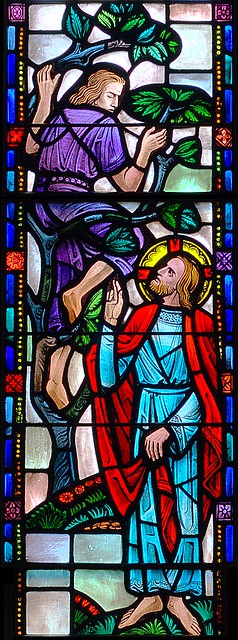
Jesus set Zacchaeus free
because he trusted in Jesus
for the forgiveness of his sins.

Scripture says in Romans 6:22-23 “You have been set free from sin and have become slaves of God, the fruit you get leads to sanctification and its end, eternal life. For the wages of sin is death, but the free gift of God is eternal life in Christ Jesus our Lord.” Jesus fulfilled God’s Law completely in our place so that through Jesus we are freed from the Law’s demands and can serve our neighbor in freedom as the Samaritan had mercy on his injured neighbor. This freedom we have in Christ is given to us as a gift by His mercy.

This gift is our inheritance as Children of God through Baptism and faith. Scripture says in Galatians 4:4-7, “But when the time had fully come, God sent his Son, born of a woman, born under law, to redeem those under law, that we might receive the full rights of sons. Because you are sons, God sent the Spirit of his Son into our hearts, the Spirit who calls out, ‘Abba, Father.’ So you are no longer a slave, but a son; and since you are a son, God has made you also an heir.”

What must you do to inherit eternal life? Of course you can’t do anything, but Christ has already done it all for you. He has redeemed you from your sin, and adopted you as His children, and He gives you the inheritance of His eternal Kingdom as a gift – as all inheritance is given. Like the Samaritan in the parable, Jesus paid the great price to make you His child and heir. St. Peter writes, “It was not with perishable things such as silver or gold that you were redeemed from the empty way of life handed down to you from your forefathers, but with the precious blood of Christ, a (sacrificial) lamb without blemish or defect.” (1 Peter 1:18-19)

Praise be to Christ, who is your Good Samaritan who sacrificed His life to rescue and heal you from the wounds of sin and death, and who gives you life everlasting.

Tuesday, December 29, 2015

The Widow’s Mite

by Pastor Paul Wolff


Jesus is the Good Samaritan
who rescued the man considered His "enemy"

Jesus taught, “Watch out for the teachers of the law. They like to walk around in flowing robes and be greeted in the marketplaces, and have the most important seats in the synagogues and the places of honor at banquets. They devour widows’ houses and for a show make lengthy prayers. Such men will be punished most severely.” (Mark 12:38-40)

Jesus warns us to beware of those who love worldly honor. Yet, who doesn’t love worldly honor? We all want people to like us and admire us. But the world doesn’t always treasure what God considers righteousness, and even when it does, those who seek praise make a pretense of righteousness and the public can be fooled.

St. John writes, “Do not love the world or anything in the world. If anyone loves the world, the love of the Father is not in him. For everything in the world – the cravings of sinful man, the lust of his eyes and the boasting of what he has and does – comes not from the Father but from the world. The world and its desires pass away, but the man who does the will of God lives forever.” (1 John 2:15-17) People are sinful and their desires are sinful. Worldly people will seek to corrupt you (if they haven’t already) in order that you will be more willing to go along with their sinful desires. At the very best, if you seek the world’s favor, they will only give it to you as long as they can get something in return. When you have nothing more to give, then the world will abandon you. There is no salvation in seeking the world’s favor and praise.


That is why James (4:4) writes, “Do you not know that friendship with the world is enmity with God? Therefore whoever wishes to be a friend of the world makes himself an enemy of God.” But understand that it is not as if God feels slighted or offended because you prefer someone else to Him. God loves you and wants you to be saved from your sins. If you seek other gods you are rejecting your only hope of salvation and will be lost.


Though the devil offered Jesus
the riches of the world,
He would not be diverted from His saving work

To illustrate this, Jesus watched the people putting money in the offering box. He noticed many rich people put in large sums of money. Jesus does not condemn them for this. It is not a sin to give large amounts of money to support the church – if God has so blessed you with wealth. The church needs money for maintenance, repair, salaries and the like. This is a good work. It is necessary for the spread of the Gospel. “Faith comes by hearing the Gospel.” How can anyone be saved if they don’t hear the message? So it is good to support the church with your tithes.

It is only a sin if you have the wrong attitude when making your offering, such as using your wealth to buy influence and control in the church. You might say, “I paid my dues, now I get to say how things are run around here.” That attitude forgets that neither the church nor your wealth belong to you – they belong to God. It is also a sin if you think your gift gets you closer to God, or makes God see you more favorably. God’s favor cannot be bought by giving to Him what belongs to Him anyway. Do you really think God will be impressed? Repent of this.

On the other hand, it is also a sin if you give all you have to the church and have nothing left for your family. It is a service to God to provide for the needs of your family. Though this, too, can be taken too far if you use your family as an excuse to get out of your obligations to the church. If you spoil your children by giving them every wicked thing they ask for, while the church is in decay and the staff is underpaid. That does no one any good – neither the church, nor your children.

Yet, instead of rebuking others for one reason or another, Jesus notices this one poor widow who put two pennies into the offering. Those who loved worldly honor and praise hardly noticed this poor widow. She could do nothing for them. Others probably didn’t take much notice of her either, but Jesus did.

Neither Mark, nor Jesus, give us her life story except to note that she is a widow, and, as such, she probably had no one to care for except herself. She apparently had no possessions to her name except those two pennies. In a way it would have made little difference to her if she spent those pennies on herself or gave it to the church. She might have been able to buy a meager amount of food for a small meal, but then she would soon have nothing again. Yet, she wanted to give her money to support the church. 


God often provides more than we need
in order that we may share with others in need

Why would she do this? Jesus doesn’t elaborate, but we can assume that this woman had great faith. She may have been almost completely destitute, but she was just grateful to be a child of God so that when she got two pennies she wanted to give them to God in thankfulness for His forgiveness and salvation, and trusting that God would see her need and provide what she needed.

God did see her and I trust that He gave her all she needed. She might never have gotten rich, but God certainly provided for her needs. We all would do well to emulate the faith of this woman.

I’m sure many sermons have been preached on this topic that said, “Be like her or else. Amen.” But if I stopped here I would be doing you a great disservice. If the only thing you get out of this Bible story is that you should strive to be like the poor widow, then you are likely to be condemned by that message.  If the lesson you take away from this is to try to emulate the widow because her actions are somehow more holy – then that would only lead you to become like the scribes who do their good works to receive something in return. 

You are most likely not like the widow in her faithfulness, but take heart – she wasn’t like that either. Well, she was, but not perfectly – not her whole life. It might have taken her losing husband and children and all her possessions for her to learn to trust in God enough to give her last two pennies in faith. She surely had many failures and sins along the way, as have you. But she wasn’t saved by her faith, nor by the large percentage of her meager possessions given to God on this one particular day. She was saved by Jesus.

You are not saved from sin and death by what you do. After you are dead, what can you do to bring yourself back to life? You can only be saved by Jesus. But then, in showing this poor widow’s offering, Jesus is teaching about what He, Himself, has done for you – not about what you should do for Him.

What made the widow special was that she gave everything she had out of love for Christ and His salvation. Now, it could have been made easier by the fact that her entire estate only included two pennies (mites), but most sinners would still put their trust in those two pennies to save them until they were gone, and then they might look to God out of desperation. Though even then, some people still would not look to God to save them even if they had nothing else to put their trust in. Jesus taught that it is easier for a camel to go through the eye of a needle than for a rich man to enter the kingdom of God. Though even poor people can make an idol out of what little they have – even two pennies. Yet, this woman’s offering didn’t save her. It wasn’t even her love and trust that saved her. If that was all she had, then it would surely be a case of: “too little – too late.” What saved her was Jesus. 


Though Christ was rich, for your sake he became poor
so that by His poverty, you may become rich.

In His essence, Jesus was not poor. Jesus is the eternal God. He created all things. Everything that exists belongs to Him. Nothing that you own or treasure so much really belongs to you. It all belongs to God. It is only by God’s gracious kindness that you have use of your possessions for a little while. We come into this world naked, and naked we shall depart. Yet, although Jesus is the creator and owner of all things, He gave up everything to pay for your sins so that you might have everything. Jesus came down from the glory of heaven to be conceived and born of the virgin Mary. He spent His first night out of the womb laying in a manger. He lived a humble life as the son of a carpenter, and in obedience to God and all His laws. Then He offered up His life as an atoning sacrifice for the sins of the world. Jesus let sinful men nail His hands and His feet to the cross, and they shouted all kinds of blasphemous insults and lies at Him while He was suffering, and then he died. Jesus gave up everything – including His life – to pay the price for your sin. “The wages of sin is death.” (Romans 6:23) “The soul that sins shall die.” (Ezekiel 18:4 & 18:20) Yet, God, Himself, in the person of Jesus, died in your place, so that you could have life forever more. Jesus gave up everything so that He could give you a share in the riches of His heavenly Kingdom.

It is because Jesus has done this that you can have the same love for God that the poor widow did in Mark 12. It is also because Jesus has done this for you that whenever you realize you frequently fall short of this ideal of faith and obedience, that you can turn to Christ in repentance and trust that He will forgive you all your sins and provide for all your needs. Since Christ has given all He had to rescue you from your sin and redeem you to be His children, you can be sure He will provide for all your needs – and then some. You may be rich, or you may never be rich, but in Christ you have the inheritance of God’s heavenly kingdom, which is worth far more than all the riches of the world.

Do not put your trust in yourself or in your riches or in your goodness. All these things will pass away, and none of them can save you. Put your trust in Jesus, who, though He was rich, became poor, so that through His poverty you might become rich. (2 Corinthians 8:9) Jesus has done everything necessary to save you from your sins and give you everlasting life. Trust in Jesus to save you. Let everything else go – it is all temporary anyway. Jesus, and His salvation is forever, and it is a sure thing. Jesus has paid for it all and has given it to you as a gift. Rejoice! Christ is your salvation.